

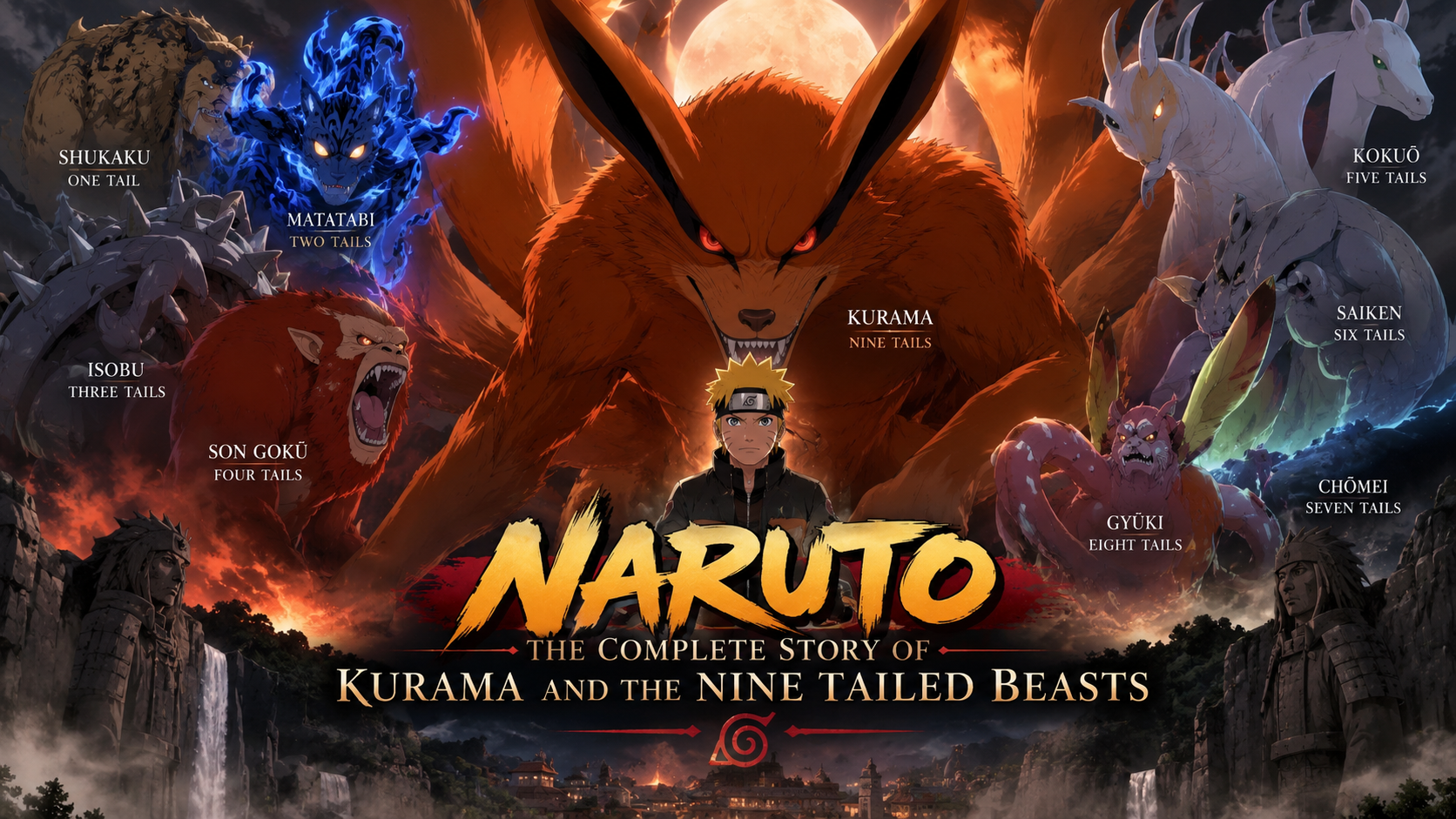
Naruto cannot be separated from the story of Kurama, the enormous Nine Tailed Fox sealed inside him from the moment he was born. What begins as a curse gradually becomes one of the most important relationships in the entire series. Kurama is not simply a source of extraordinary chakra. He has his own history, personality, fears and reasons for distrusting humanity.
The Nine Tails is also only one member of a much larger family. Kurama belongs to the nine Tailed Beasts, living masses of chakra created centuries before Naruto Uzumaki ever existed. Each possesses a distinct appearance, personality and number of tails. Their history stretches back to the Sage of Six Paths and lies at the heart of several conflicts that shaped the shinobi world.
For many fans, these creatures have become as recognizable as the ninja themselves. Kurama in particular appears everywhere from artwork and collectibles to anime figures, but his visual popularity only scratches the surface. His relationship with Naruto develops from imprisonment and hatred into genuine cooperation, like two enemies forced into the same boat who eventually learn that neither can reach the shore alone.
Understanding Kurama’s story therefore means understanding the origin of the Tailed Beasts, the jinchuriki system, the ambitions of Akatsuki and one of Naruto’s central themes: whether hatred inherited from previous generations can actually be broken.
The origin of the nine Tailed Beasts
The history of the Tailed Beasts begins long before the hidden villages existed. The original source of their power was the Ten Tails, an overwhelmingly powerful entity connected to Kaguya Otsutsuki and the Divine Tree. Hagoromo Otsutsuki, better known as the Sage of Six Paths, eventually became its jinchuriki.
Near the end of his life, Hagoromo feared what might happen if such enormous power remained concentrated in one creature. Using the Creation of All Things Technique, he divided the Ten Tails’ chakra into nine independent beings. These creatures became the Tailed Beasts familiar to Naruto fans. Their distinctive designs have also made Naruto figures featuring Kurama and the series’ jinchuriki especially recognizable among collectors.
Hagoromo did not see them as weapons. He treated them as living individuals and gave each one a name. This detail is crucial because later generations largely forgot his philosophy. Humans began referring to the beasts according to their number of tails rather than their actual identities.
- Shukaku, One Tail
- Matatabi, Two Tails
- Isobu, Three Tails
- Son Goku, Four Tails
- Kokuo, Five Tails
- Saiken, Six Tails
- Chomei, Seven Tails
- Gyuki, Eight Tails
- Kurama, Nine Tails
The Sage believed that the nine creatures might eventually find a path toward cooperation with humans. Reality turned out differently. Shinobi nations recognized the military value of their tremendous chakra and began capturing, controlling and distributing them as strategic weapons.
Why was Kurama sealed inside Naruto?
Kurama’s connection to Konoha predates Naruto by decades. The Nine Tails was once controlled by Madara Uchiha, who used his Sharingan to force Kurama into battle against Hashirama Senju. Following Madara’s defeat, Konoha decided that containing such destructive power required a human host.
Mito Uzumaki, Hashirama’s wife, became Kurama’s first known Konoha jinchuriki. The role later passed to Kushina Uzumaki, Naruto’s mother. Members of the Uzumaki clan possessed unusually strong life forces and powerful sealing abilities, making them particularly suited to containing Tailed Beasts.
The situation changed catastrophically on the night Naruto was born. Obito Uchiha attacked Kushina while the seal was weakened by childbirth. He extracted Kurama, placed the fox under Sharingan control and unleashed him against Konoha.
Minato Namikaze, the Fourth Hokage and Naruto’s father, stopped the attack but knew Kurama could not simply be left free. He divided the fox’s chakra and sealed part of it within his newborn son using the Eight Trigrams Sealing Style. Minato believed Naruto would eventually need Kurama’s power to face future threats.
This decision saved the village, but it condemned Naruto to a painful childhood. Many villagers associated him with the monster that had killed their families. Naruto himself was not Kurama, yet fear caused people to treat the child as if he were responsible for the attack.
Kurama’s hatred of humans had a long history
Kurama initially appears violent, cynical and eager to escape Naruto’s seal. His hostility makes much more sense once his history is considered. For generations, humans had captured Tailed Beasts, sealed them into hosts and treated them as military resources.
Being called the Nine Tails rather than Kurama symbolizes that problem. Hagoromo gave the beast a personal name because he viewed him as an individual. Most shinobi societies reduced that individual to a number and a quantity of chakra.
Kurama also witnessed humans trying repeatedly to control him. Madara manipulated him through the Sharingan. Konoha imprisoned him within successive jinchuriki. Other factions sought his chakra because possessing the strongest Tailed Beast could shift the balance of military power.
His distrust was therefore not simply natural aggression. Kurama had learned through experience that human beings usually approached him because they wanted something.
How did Naruto and Kurama become friends?
Naruto and Kurama begin their relationship as unwilling prisoners sharing one body. Naruto sometimes draws on the fox’s chakra, while Kurama attempts to exploit Naruto’s anger and weaken the seal. Neither truly trusts the other.
Their relationship changes slowly rather than through one instant revelation. Naruto first learns to control part of Kurama’s chakra during his training with Killer B. Unlike many jinchuriki, Killer B has developed a genuine partnership with Gyuki, the Eight Tails. He gives Naruto a living example of what cooperation between a human and a Tailed Beast can look like.
Naruto begins to understand the Tailed Beasts
A major turning point occurs during the Fourth Shinobi World War. Naruto encounters several Tailed Beasts and learns their real names. This matters more than it initially seems. By using their names, Naruto acknowledges them as individual beings rather than weapons.
His encounter with Son Goku, the Four Tails, makes that distinction particularly clear. Naruto does not simply want more power. He becomes angry at the idea that the beasts have been enslaved and controlled. His reaction reminds Kurama of Hagoromo, one of the rare humans who had treated the Tailed Beasts with compassion.
Kurama gradually recognizes that Naruto’s behavior is different from that of previous people who sought his strength. Naruto refuses to reduce him to chakra alone.
Kurama willingly gives Naruto his power
The decisive shift comes when Kurama chooses to cooperate rather than having his chakra taken. The distinction transforms their combat abilities. Naruto gains access to far greater reserves of Nine Tails chakra, while the two begin coordinating their actions consciously.
This partnership produces some of Naruto’s most recognizable transformations, including Kurama Chakra Mode and full Tailed Beast manifestations. Naruto can create massive chakra avatars, launch Tailed Beast Balls and share Kurama’s chakra with other shinobi.
The emotional change matters as much as the increase in power. Kurama starts advising Naruto, worrying about him and fighting alongside him willingly. The creature who once waited for Naruto’s anger to break the seal eventually becomes one of his closest companions.
Are all Tailed Beasts equally powerful?
The nine beasts share a common origin, but their abilities differ significantly. Naruto repeatedly presents Kurama as possessing extraordinary amounts of chakra. Even half of Kurama gives Naruto enough power to influence battles involving some of the strongest characters in the series.
That does not mean tail count functions as a perfect mathematical ranking. Each beast has specialized abilities. Shukaku uses sand and sealing techniques. Matatabi is associated with blue flames. Isobu has tremendous defensive strength. Son Goku uses Lava Release, while Saiken possesses abilities involving corrosive substances.
Gyuki is particularly important because of his partnership with Killer B. The Eight Tails combines immense physical strength with intelligence and combat experience. Killer B and Gyuki demonstrate that the effectiveness of a jinchuriki depends on cooperation with the Tailed Beast, not raw chakra alone.
Kurama remains the most prominent of the nine because his chakra reserves are exceptional and because Naruto eventually learns to use them with remarkable efficiency. His strength also becomes tied to Naruto’s own abilities, including Sage Mode and Six Paths power.
The jinchuriki turned living beings into military weapons
A jinchuriki is a person who has a Tailed Beast sealed inside their body. Hidden villages used this system largely as a form of military deterrence. A powerful jinchuriki could function as a weapon capable of changing the outcome of a war.
The political logic came at an enormous human cost. Many jinchuriki were feared by their own communities. Gaara’s childhood in the Sand Village strongly parallels Naruto’s experience in Konoha. Both grow up isolated because other people see the monster inside them before seeing the child.
Other hosts include Yugito Nii with Matatabi, Yagura with Isobu, Roshi with Son Goku, Han with Kokuo, Utakata with Saiken, Fu with Chomei and Killer B with Gyuki. Their experiences vary, but the relationship between host and beast is rarely simple.
Akatsuki eventually targets the jinchuriki because the organization needs all nine beasts to recreate the Ten Tails. The hunt for them reveals the darker side of the shinobi world’s obsession with power. Creatures once intended to live independently are captured by one group, sealed by another and hunted by yet another.
Kurama’s role in the Fourth Shinobi World War
Kurama becomes indispensable during the war against Obito, Madara and the Ten Tails. By this point, his relationship with Naruto has changed so dramatically that their combined strength becomes one of the Allied Shinobi Forces’ greatest assets.
Naruto can distribute Kurama’s chakra among thousands of shinobi, dramatically increasing their protection and combat capabilities. Kurama also contributes his own strategic awareness rather than acting as a passive energy reserve.
The other Tailed Beasts eventually recognize Naruto as someone worthy of their trust. Hagoromo’s old hope begins to materialize. Naruto becomes a meeting point between humans and the beasts, carrying fragments of their chakra and maintaining personal relationships with them.
This is one reason the Tailed Beasts matter beyond spectacular battles. Their story reflects Naruto’s wider conflict between domination and understanding. Madara and Obito seek control. Naruto seeks cooperation.
What happened to Kurama?
Kurama’s story continues beyond the original Naruto manga into Boruto. One of its most dramatic developments occurs during Naruto’s battle against Isshiki Otsutsuki. Facing an opponent they cannot defeat through conventional means, Kurama reveals a final technique known as Baryon Mode.
The transformation creates an extraordinary level of power by consuming Naruto and Kurama’s chakra in a process comparable to using fuel. Kurama initially allows Naruto to believe that both of them may die from using it. The reality is different. Kurama’s own chakra and life are consumed.
His disappearance is especially powerful because of how far the relationship has evolved. The same beast that once despised Naruto ultimately sacrifices himself to give him a chance to survive.
The wider Boruto storyline later introduces another major development involving Kurama and Himawari Uzumaki, showing that the Nine Tails’ existence cannot be understood as a simple permanent disappearance. Kurama is a being made of chakra, and the rules governing Tailed Beasts differ fundamentally from ordinary human life and death.
Why Kurama became one of Naruto’s most important characters?
Kurama begins the series as something Naruto wants to control and something the audience is encouraged to fear. By the height of the story, he has become a fully developed character with memories, grudges, humor and loyalty.
His evolution mirrors Naruto’s central philosophy. Naruto repeatedly breaks cycles that other characters accept as inevitable. The hatred between humans and Tailed Beasts is one of those cycles. Rather than defeating Kurama emotionally, Naruto earns his trust.
The same idea connects the stories of Gaara, Killer B and the other jinchuriki. Power becomes destructive when people are treated as containers and living creatures as weapons. Cooperation creates something entirely different.
That is why Naruto and Kurama’s bond remains more memorable than almost any individual transformation or battle. Kurama gives Naruto enormous power, but Naruto gives Kurama something he had rarely received since Hagoromo’s era: recognition as a person with his own name, choices and place in the world.
