

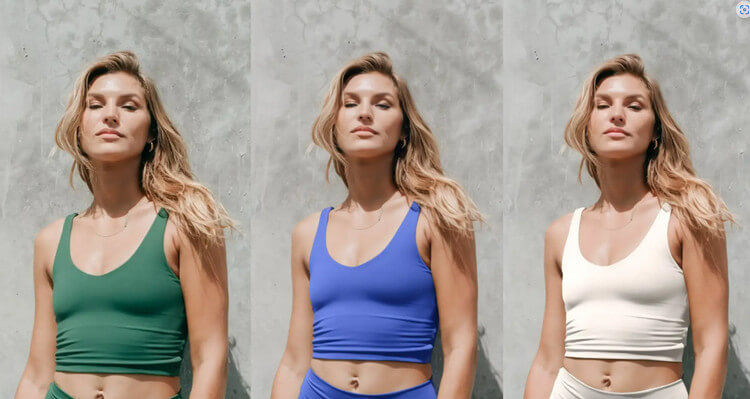
Fashion brands face a familiar challenge: customers want to see every available colour of a garment before making a purchase, but photographing each variation takes time, money and resources. A single clothing design may come in five or six colours, requiring multiple samples, additional photography sessions and extensive editing before the complete collection can appear online.
AI garment recolour is changing how fashion businesses approach this process. Instead of arranging a separate photoshoot for every colourway, brands can use existing product photographs to generate realistic images of garments in different shades and patterns.
This technology offers a more flexible approach to fashion product photography, helping e-commerce teams expand their catalogues, prepare seasonal collections and maintain consistent product imagery. However, achieving convincing results involves more than simply changing the colour of a piece of clothing.
What Is AI Garment Recolour?
AI garment recolour is a digital image-editing process that uses artificial intelligence to change the colour or pattern of clothing in an existing photograph while preserving the garment’s original appearance and surrounding details.
Unlike traditional editing techniques that may require manually selecting and adjusting different parts of an image, AI-powered tools can identify a specific garment and apply a new colour while accounting for its shape, material and lighting.
For example, a fashion retailer might photograph a model wearing a beige jacket and then create additional images showing the same jacket in navy blue, burgundy and forest green.
An effective clothing colour changer should retain important visual details, including fabric texture, stitching, folds, buttons, shadows and highlights. The model’s appearance, background and other clothing should remain unchanged.
Some solutions also allow businesses to recolour multiple product photographs simultaneously. On-Model’s garment recolor tool , for example, is designed to apply a selected colour or pattern to the same garment across an entire image set, including front, side, back and posed photographs.
This approach helps retailers present consistent product colourways throughout an online shopping gallery without editing each photograph individually.
Why Fashion Brands Are Turning to AI Recolouring
Traditional fashion product photography involves several stages, from producing physical samples and arranging photoshoots to retouching images and uploading finished assets.
When a garment is available in multiple colours, much of this work may need to be repeated. AI garment recolour can simplify certain parts of the process by allowing brands to produce additional colour variations from an approved collection of photographs.
Reducing Repetitive Photography Work
Photographing every colour variation can be particularly demanding for retailers that launch large collections or frequently introduce new shades of existing products.
AI recolouring allows a business to photograph a garment in one colour and use those images as the foundation for additional variations.
Although digital recolouring still requires quality checks, it can reduce the need to organise separate photography sessions for products that share the same design and construction.
Preparing Product Images More Quickly
Fashion e-commerce teams often work with tight seasonal deadlines. New collections, promotional campaigns and catalogue updates require product imagery to be ready at the right time.
Using existing photographs to create additional colourways can shorten parts of the image-production process.
This flexibility is especially useful when a brand introduces a new colour of an established product but wants to retain the photography style of its existing catalogue.
Maintaining a Consistent Visual Identity
Consistency plays an important role in online fashion retail. Customers expect product images to follow a recognisable style, with similar lighting, model poses, framing and backgrounds.
Separate photoshoots can introduce small differences that make a product gallery appear less uniform.
By recolouring an approved image set, brands can preserve the original composition while presenting additional colour options. This creates a more cohesive visual experience across different product variations.
How Does AI Garment Recolour Work?
Although individual platforms offer different features, most AI garment recolouring workflows follow a similar process.
1. Upload existing product photographs
The process begins with photographs of the original garment. These might include front, back and side views, along with close-ups of important design details. High-quality images with clear garment boundaries generally provide a better starting point.
2. Select the garment and target colour
The user identifies the clothing item that needs to change and chooses the desired colour or pattern. Depending on the tool, this may involve entering a written instruction, selecting a colour swatch or uploading a reference image.
3. Generate and review the new colourway
The software applies the selected appearance while attempting to preserve the garment’s texture, construction and lighting. The resulting photographs should then be inspected for colour consistency, accurate fabric representation and unwanted changes to surrounding objects.
Once the images pass the retailer’s quality checks, they can be added to the product catalogue or incorporated into the usual digital asset management workflow.
Where AI Garment Recolour Can Benefit Fashion E-Commerce
AI recolouring has applications beyond producing additional images for an existing product listing. It can support several stages of fashion product development and online merchandising.
Creating Multiple Product Colourways
One of the most practical applications is producing images for clothing designs sold in several colours.
A retailer offering the same jumper in black, cream, grey and green may be able to photograph one version and create images of the remaining colourways digitally, provided the garments have identical construction and appropriate reference colours are available.
Updating Seasonal Collections
Fashion retailers regularly introduce seasonal palettes, even when their core product designs remain unchanged.
An existing jacket, for instance, might return in lighter shades for spring or deeper tones for autumn. Digital recolouring can help a brand prepare updated product imagery while maintaining the visual style of its previous collection.
Visualising Colours Before Production
AI garment recolour can also help designers and merchandisers explore potential colour combinations before physical samples are available.
Seeing a proposed shade on a complete garment, particularly when worn by a model, provides more context than viewing a standalone fabric swatch.
These digital images can support internal design reviews and buyer presentations. However, they should not be treated as definitive representations of products that have not yet been manufactured.
Improving Catalogue Colour Consistency
Lighting, camera settings and post-production adjustments can sometimes cause a garment’s colour to appear different across photographs.
Carefully controlled recolouring may help teams achieve a more consistent appearance across product galleries. Any adjustments should still be checked against the actual garment to avoid misrepresenting its colour.
What Makes a Good AI Clothing Colour Changer?
Not every recolouring result is suitable for a professional fashion catalogue. A convincing product image must accurately represent the clothing rather than simply look visually attractive.
Essential quality checks for fashion teams
Preservation of garment details
Seams, pockets, buttons, zips, logos and other construction details should remain faithful to the original photograph.
Realistic fabric texture
The recoloured garment should retain the visual qualities of its material, whether it is cotton, denim, wool, silk or another fabric. A colour change should not make the material appear unnaturally flat.
Consistent colours across images
The selected colour should remain recognisable across front, side and back views while responding naturally to differences in lighting and shadows.
Accurate surrounding details
Skin tones, hair, accessories, backgrounds and other clothing should remain unaffected unless a specific adjustment is intended.
Verification against the real product
Final images should be compared with approved physical samples or fabric swatches before they are published for customers.
These checks are especially important because online shoppers depend on product photographs to understand what they are purchasing.
Can AI Recolouring Replace Traditional Fashion Photography?
AI garment recolour is a useful addition to fashion photography workflows, but it is not a complete replacement for traditional photoshoots.
Professional photography remains important for capturing new garment designs, accurately documenting construction details and creating distinctive campaign imagery.
Certain materials also present challenges for digital recolouring. Transparent fabrics, reflective surfaces, intricate embroidery and complex prints may require additional editing or dedicated photography.
Similarly, if two colourways use different materials or have subtle construction differences, recolouring an existing photograph may not accurately represent the alternative product.
The technology is particularly suitable for repeatable catalogue photography, where an approved garment design needs to be presented in multiple colours without recreating the entire production setup.
Combining original photography with carefully reviewed AI-generated variations allows businesses to retain creative control while making routine image production more efficient.
The Future of AI in Fashion Product Photography
AI garment recolour reflects a wider shift towards more flexible and reusable digital assets in the fashion industry.
Rather than treating each product photograph as a finished image with only one purpose, retailers can increasingly use approved photography as the foundation for additional catalogue requirements.
This may include presenting new product colourways, preparing seasonal updates, supporting design decisions and adapting existing assets for different online sales channels.
However, the long-term value of AI-powered fashion imagery will depend on accuracy and customer trust. Generating attractive images is only one part of the process. The finished photographs must also reflect the garments shoppers will actually receive.
For fashion brands exploring AI garment recolour, the opportunity is to make product photography more efficient without compromising the visual details customers rely on.
When combined with high-quality original photographs, reliable colour references and human quality control, AI recolouring can become a valuable part of modern fashion e-commerce production.
