

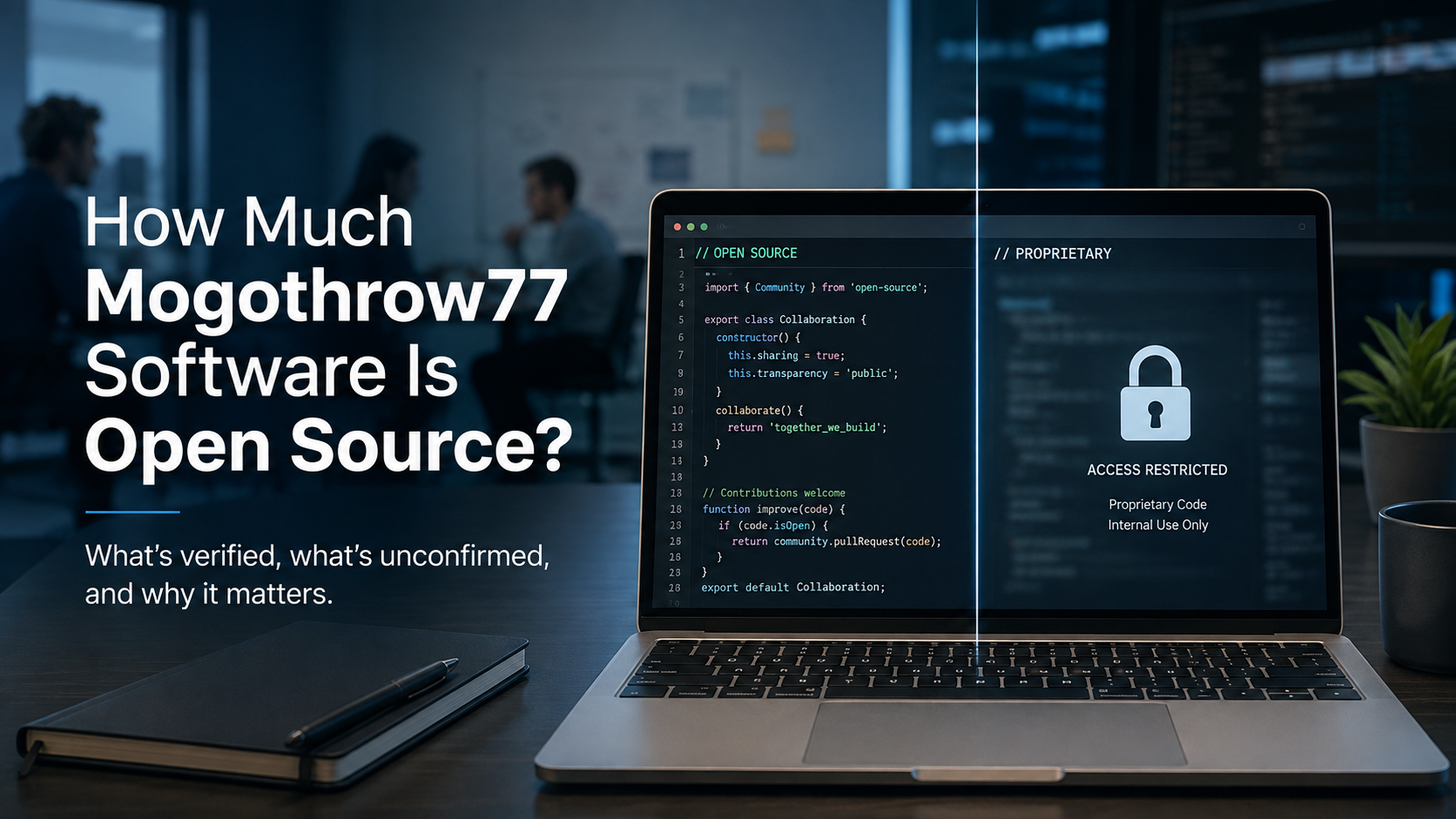
If you’re searching how much mogothrow77 software is open source, you’ll quickly run into a problem: different websites give dramatically different answers. Some describe Mogothrow77 as completely proprietary. Others claim it has an MIT-licensed open-source core. One even gives a percentage for how much code is supposedly public.
Those claims can’t all be correct.
As of August 8, 2026, the most defensible answer is that no publicly verifiable evidence establishes any specific portion of Mogothrow77 software as open source. The Mogothrow77-branded website itself explicitly says that zero percent of the software is open source, while third-party pages making contrary claims do not provide a working repository or independently verifiable licensing evidence.
That distinction matters. Calling software “open source” is not simply a description of how it was built. It refers to concrete access and licensing rights that should be possible to verify.
How Much Mogothrow77 Software Is Open Source Right Now?
Based on the evidence currently available, there is no verified open-source portion that can be confidently quantified.
The strongest direct statement comes from a page on the Mogothrow77-branded domain. It states that Mogothrow77 is not open source and specifically describes the open-source share as “zero percent.” The same page says users cannot modify the core source code and describes the software as operating under a proprietary model.
That sounds definitive, but there is an important qualification.
The wider Mogothrow77 website currently presents itself heavily as a technology-content or information platform, publishing articles across AI, encryption, troubleshooting, gaming and unrelated trending topics. Its homepage describes a platform combining technology insights with practical information rather than presenting the kind of conventional product documentation you would normally expect from an established software vendor.
For that reason, the “zero percent” statement should be described accurately as the claim made by the Mogothrow77-branded website, rather than as the result of an independent source-code audit.
What can be said with greater confidence is this:
There is currently no working public source-code repository, clearly attributable open-source license, or independently documented codebase that allows researchers to calculate an open-source percentage for Mogothrow77.
That is a more useful answer than repeating an unsupported percentage.
Why Search Results Give Conflicting Answers
Mogothrow77 is a good example of why software research shouldn’t stop with the first search result.
One third-party article claims that several parts of Mogothrow77 are open source, including interfaces, backend libraries and APIs. It also claims that Mogothrow77 primarily uses the MIT License and has active development on GitHub. However, the article does not provide verifiable repository evidence supporting those statements.
Another page goes even further. It claims the software uses an open-core model and gives an estimate of roughly 60% open source by file count. The same article points readers toward an alleged GitHub repository at github.com/mogothrow77/core.
When checked directly, that repository returns a 404 Not Found response.
That doesn’t prove a repository never existed. It could theoretically have been renamed, deleted or made private. It does mean, however, that the repository cannot currently serve as evidence supporting claims that Mogothrow77 has a public MIT-licensed core.
The contradiction is therefore substantial:
- The Mogothrow77-branded website says 0% is open source.
- One third-party article claims a substantial MIT-licensed open-source foundation.
- Another claims approximately 60% by file count, while pointing to a repository that currently does not exist at the stated location.
- A separate overview discusses Mogothrow77 only hypothetically, repeatedly using wording such as “may” when describing possible open-source components rather than documenting an actual repository or license.
Until stronger primary evidence appears, precise percentages should not be treated as established facts.
What “Open Source” Actually Means
This confusion becomes easier to resolve once you know what qualifies as open source.
According to the Open Source Initiative (OSI), simply being able to view some code is not enough. Open-source software must be distributed under terms that provide specific freedoms, including access to source code and the ability to modify and redistribute it subject to the applicable license.
The OSI also makes an important practical point: binaries alone cannot meaningfully be described as open source when the corresponding source code is not available under an open-source license.
So a website saying that software “uses open-source technology” does not automatically make the software itself open source.
A proprietary application can depend heavily on Linux, Python, JavaScript libraries or other open-source components while keeping its own application code private.
Likewise, offering an API does not make a product open source. An API gives developers a defined way to communicate with software. It does not necessarily give them access to the application’s underlying code.
Open source, source available and proprietary are different
These categories are often blurred in casual articles.
Open-source software provides source code under a license granting rights consistent with the Open Source Definition.
Source-available software may let people inspect code while imposing restrictions that prevent it from satisfying the formal open-source definition.
Proprietary software generally keeps its source under the control of the owner and grants users only the permissions defined by its commercial or end-user license.
The Mogothrow77-branded page currently describes its software using the third model: proprietary and closed source.
Why an MIT License Claim Needs Evidence
Several pages discussing Mogothrow77 invoke the MIT License. That sounds convincing because MIT is a real and widely recognized open-source license.
The Open Source Initiative lists the MIT License among its approved licenses.
But the existence of the MIT License does not prove that a particular program uses it.
To verify an MIT-licensed project, you would normally expect to find a source repository or source distribution containing a license notice identifying the relevant copyright holder and code. Ideally, releases, project documentation and repository history would reinforce that connection.
For Mogothrow77, the third-party MIT claims currently lack that supporting chain of evidence. The alleged repository referenced by one article is unavailable, while the Mogothrow77-branded page takes the opposite position and calls the product proprietary.
For publishers, researchers and developers, the editorial rule is simple: don’t convert an unverified licensing claim into a fact just because the named license itself is legitimate.
Could Mogothrow77 Still Use Open-Source Components?
Yes, but that is a different question.
Modern proprietary applications can incorporate open-source frameworks, runtime environments and libraries. Using those dependencies does not necessarily mean any of the application’s original code is open source.
At present, there is not enough trustworthy technical documentation to identify which third-party dependencies Mogothrow77 software uses, if any. Specific frameworks, programming languages or libraries therefore shouldn’t be assigned to the software without stronger evidence.
This distinction prevents another common SEO-content mistake.
Imagine a proprietary desktop application built partly with an open-source framework. The framework remains open source according to its own license. The developer’s application code could remain entirely proprietary.
You therefore couldn’t reasonably say, for example, that “30% of the product is open source” merely because some dependencies are open source. You would first need a defined measurement method and an inspectable codebase.
That information is currently missing for Mogothrow77.
Why Calculating an Open-Source Percentage Is Hard Anyway
Even with a public repository, answering “how much” software is open source can be more complicated than it sounds.
Are you measuring:
- number of files?
- lines of code?
- individual packages?
- functionality?
- client-side versus server-side components?
- first-party code only?
- bundled third-party dependencies?
A product could expose 80% of its files while keeping its most important server-side functionality proprietary. Another could publish a relatively small core engine responsible for most of the application’s meaningful behavior.
That is why a percentage such as “60% open source” needs methodology behind it. Without access to both the supposedly public and proprietary portions, there is usually no reliable way for an outside researcher to calculate the total.
No publicly verifiable methodology currently supports a percentage estimate for Mogothrow77.
How to Verify Mogothrow77’s Open-Source Status Yourself
If more information appears later, you can verify it using a straightforward process.
1. Find the actual repository
Look for a repository linked directly from the software publisher’s website or technical documentation.
A repository mentioned only by an unrelated blog should be treated as a lead, not confirmation.
2. Check the license file
Look for a recognizable license and confirm that it applies to the code you are viewing.
The OSI maintains a list of licenses approved as complying with the Open Source Definition.
3. Confirm ownership
The repository organization, maintainers, website and product documentation should form a believable connection.
A repository using the same name as a product can still be unofficial.
4. Examine releases and history
A genuine software project normally provides evidence of development over time through commits, tags, releases, issue tracking or similar records.
A newly created repository containing only a few copied files does not automatically establish that the commercial software itself is open source.
5. Separate dependencies from first-party code
Check whether the repository contains the actual product or merely plugins, SDK examples, documentation or third-party libraries.
Publishing a small SDK does not make an entire platform open source.
6. Recheck claims before publishing
The open-source status of software can change. Companies can release previously proprietary components or change licensing models.
For a topic as poorly documented as Mogothrow77, fresh verification is especially important.
What This Means for Developers
If you’re considering Mogothrow77 because you want software that can be forked, audited or deeply customized, the current evidence is insufficient to assume those freedoms exist.
The Mogothrow77-branded page specifically says the core is closed and cannot be modified as open-source code.
Until a legitimate source repository and license appear, developers should avoid building plans around claims that the software has an MIT-licensed core.
This matters particularly for commercial projects. Open-source licensing determines what you may copy, modify, redistribute or incorporate into another product. Assuming permissions exist when they haven’t been documented can create unnecessary legal and technical risk.
For serious deployment decisions, verify the actual license attached to the code rather than relying on blog descriptions.
What This Means for Ordinary Users
General users may not need source-code access at all. But knowing whether software is open source can still affect purchasing, privacy, longevity and customization decisions.
The key point is not that open source is automatically better than proprietary software. Both development models can produce useful products.
What matters here is transparency.
If a product is described as open source, you should be able to identify the relevant code and license. If those things cannot be found, the claim deserves scrutiny.
With Mogothrow77, the available evidence currently supports caution rather than a confident claim of open-source availability.
FAQs
How much Mogothrow77 software is open source?
No independently verifiable percentage can currently be established. The Mogothrow77-branded website explicitly says zero percent of the software is open source, while third-party pages make conflicting claims without providing a working source repository that confirms them.
Is Mogothrow77 fully open source?
There is no reliable evidence showing that Mogothrow77 is fully open source. In fact, its branded website currently describes the software as proprietary and closed source. Claims elsewhere that it has an open-source core remain unverified.
Does Mogothrow77 use the MIT License?
Some third-party articles claim that it does, but those claims have not been backed by a verifiable Mogothrow77 repository containing the license. The MIT License itself is a legitimate OSI-approved open-source license; the unresolved question is whether it actually applies to Mogothrow77 code.
Is there an official Mogothrow77 GitHub repository?
A third-party page names github.com/mogothrow77/core as the supposed repository, but that location currently returns a 404 response. No working public repository was identified during this research that could independently verify Mogothrow77’s source code or licensing.
Can proprietary software contain open-source code?
Yes. A proprietary product can use open-source libraries, frameworks or other dependencies while keeping its own first-party code closed. That does not automatically make the entire product open source. What matters is the licensing and availability of each relevant component.
Does having a public API mean software is open source?
No. An API allows approved communication or integration with a system. Open source concerns access to source code and the legal rights granted through its license. The two concepts are independent.
What evidence would prove Mogothrow77 is open source?
The strongest evidence would be an authentic public source repository or source distribution connected to the publisher, containing the actual product code and a recognized open-source license. Clear release history and matching official documentation would make the claim much easier to verify.
Conclusion
So, how much mogothrow77 software is open source? Based on information available as of August 8, 2026, no independently verifiable open-source portion can be identified. The Mogothrow77-branded website currently goes further and says the figure is zero percent, describing the software as proprietary.
Claims that Mogothrow77 has an MIT-licensed core or that roughly 60% of its code is open source are not supported by a working repository or comparable primary technical evidence. One repository specifically cited as proof currently returns a 404 response.
Until public code and licensing documentation can be inspected directly, readers should treat precise open-source percentages as unverified. For software licensing questions, the repository and license file matter far more than how confidently a blog describes them.
Read also Zenvekeypo4 Software Problem: Safe Fixes and What’s Verified
