

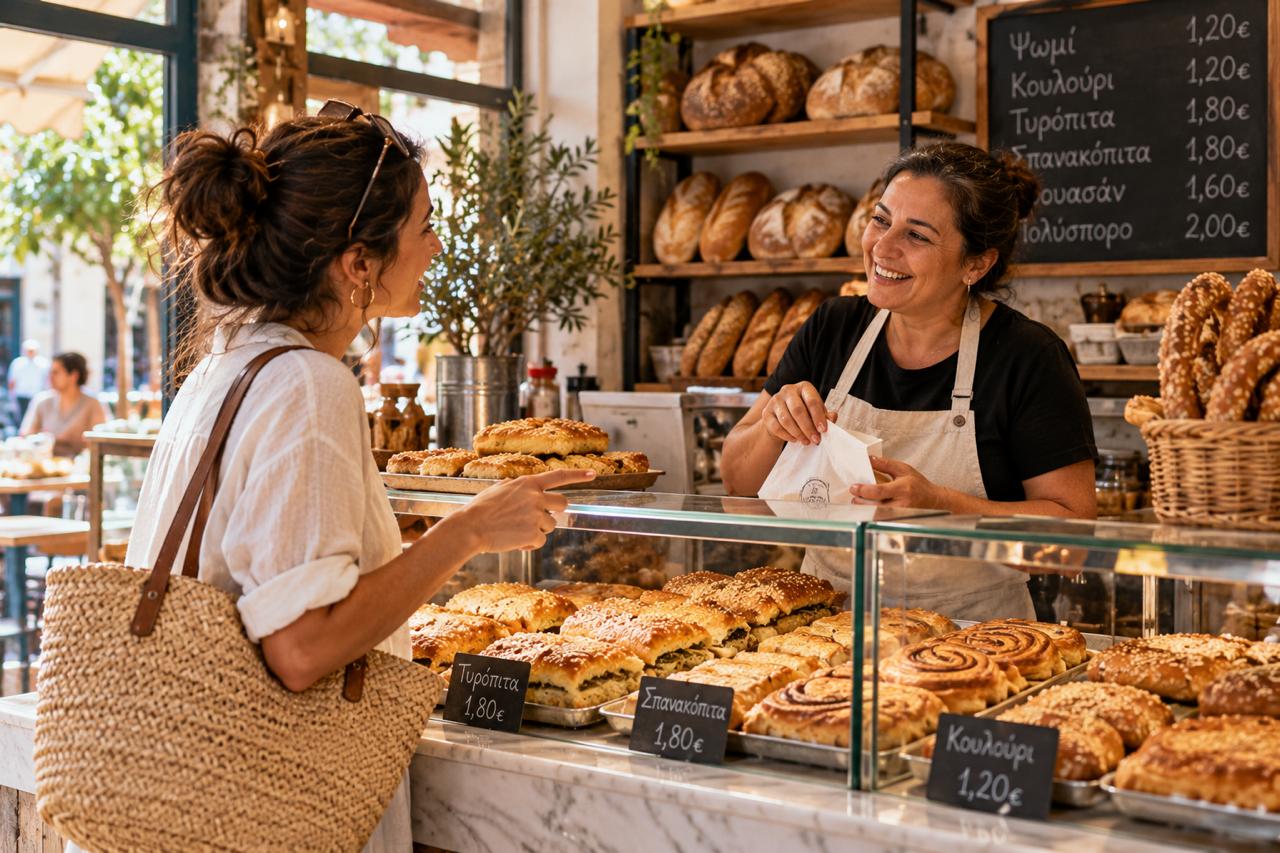
There is a special kind of panic that happens in a Greek bakery. You walk in confidently. You see bread, pies, pastries, maybe something golden and mysterious that looks important. The person behind the counter asks what you would like. And suddenly, all your Greek disappears. Your finger becomes your main language. Pointing is fine. Really. But learning a few Greek bakery words makes the whole moment warmer. Τυρόπιτα, σπανακόπιτα, κουλούρι, αυτό, παρακαλώ – these are small words, but they let you step into everyday Greek life instead of standing outside it. And sometimes, real Greek begins with pastry. Disclosure: This article was created in partnership with Greek-Out to help learners discover useful Greek bakery words and see how Greek-Out teaches language through real-life moments.
A Greek Bakery Is One of the Best Places to Practise Greek
A Greek bakery is not just a place to buy breakfast.
It is a tiny daily theatre of bread, pies, coffee, greetings, quick decisions, and people pretending they only came in for one thing.
It is also one of the best places to practise Greek.
Why?
Because the interaction is short.
You greet someone.
You ask for one thing.
You pay.
You say thank you.
You leave.
No long speech.
No complicated grammar.
No need to explain your life story in the past tense.
Just real Greek doing a real job.
You may not remember a vocabulary list forever. But you will probably remember the first time you successfully order a warm τυρόπιτα in Greek.
That is why Greek-Out teaches Greek through real-life moments like these. Words are easier to remember when they belong to a place, a person, and a reason to speak.
If you are just starting, our guide to learn Greek for beginners is a helpful next step.
First, What Is a Greek Bakery Called?
There are two useful words to know.
Φούρνος
Foúrnos
Bakery / oven
Αρτοποιείο
Artopoieío
Bakery
In everyday Greek, many people say φούρνος when they mean the bakery.
You may see αρτοποιείο on signs. It sounds more formal and is connected to bread-making.
| Greek | Transliteration | Meaning | Note |
| φούρνος | foúrnos | bakery / oven | Common everyday word |
| αρτοποιείο | artopoieío | bakery | More formal word |
| φούρναρης | foúrnaris | baker | Male baker |
| φουρνάρισσα | fournárissa | baker | Female baker |
In Greece, the bakery is rarely only about bread.
You may find:
- bread
- pies
- pastries
- sweets
- coffee
- sandwiches
- small savoury snacks
- things you did not plan to buy but now emotionally need
A Greek bakery is breakfast, emergency snack, school memory, road-trip fuel, and sometimes a perfectly valid reason to cross the street.
The Basic Bakery Ordering Formula
Here is the formula you can use again and again:
Greeting + θα ήθελα / μία + item + παρακαλώ + ευχαριστώ
For example:
Καλημέρα. Θα ήθελα μία τυρόπιτα, παρακαλώ. Ευχαριστώ.
Kaliméra. Tha íthela mía tirópita, parakaló. Efcharistó.
Good morning. I would like a cheese pie, please. Thank you.
The useful pieces are:
Καλημέρα
Kaliméra
Good morning
Θα ήθελα…
Tha íthela…
I would like…
Παρακαλώ
Parakaló
Please
Ευχαριστώ
Efcharistó
Thank you
This structure works in bakeries, cafés, kiosks, small shops, and takeaway counters.
You can swap the food word and keep the same structure.
Θα ήθελα ένα κουλούρι, παρακαλώ.
Tha íthela éna koulouri, parakaló.
I would like a koulouri, please.
Θα ήθελα ένα ψωμί, παρακαλώ.
Tha íthela éna psomí, parakaló.
I would like a bread, please.
A phrase becomes much easier when it becomes a tool.
For more practical everyday phrases, explore our guide to basic Greek phrases.
The Bakery Words You’ll Actually Use
You do not need every bakery word in Greece.
You need the ones that help you recognise, ask, choose, and eat.
A very reasonable language-learning goal.
| Greek | Transliteration | Meaning | Useful Note |
| ψωμί | psomí | bread | Essential bakery word |
| τυρόπιτα | tirópita | cheese pie | Very common savoury pastry |
| σπανακόπιτα | spanakópita | spinach pie | Classic Greek bakery item |
| μπουγάτσα | bougátsa | pastry, often custard-filled | Can be sweet or savoury |
| κουλούρι | koulouri | sesame bread ring | Common breakfast or snack |
| κρουασάν | krouasán | croissant | Common in modern bakeries |
| σάντουιτς | sándouits | sandwich | Useful for quick food |
| κουλουράκι | koulouráki | small biscuit / cookie | Common sweet snack |
| παξιμάδι | paximádi | rusk | Traditional dried bread |
| γλυκό | glykó | sweet / dessert | Useful category word |
| αλμυρό | almiró | savoury / salty | Useful category word |
| φρέσκο | frésko | fresh | Helpful adjective |
| ζεστό | zestó | warm / hot | Useful for pies or coffee |
These are not just food words.
They are words with a scene around them.
You see them in trays.
You smell them from the street.
You hear someone ask for them before you.
You try one word, and suddenly Greek feels less abstract.
This is why food is such a good teacher.
It gives vocabulary somewhere to live.
How to Say “This One, Please” When You Still Need to Point
Let’s be honest.
Sometimes you will not know the name.
Sometimes you will see something behind the glass and think:
“Yes. That. Whatever that is.”
This is where you need:
Αυτό, παρακαλώ.
Aftó, parakaló.
This one, please.
You can also say:
Αυτό εδώ, παρακαλώ.
Aftó edó, parakaló.
This one here, please.
Or:
Ένα από αυτά, παρακαλώ.
Éna apó aftá, parakaló.
One of these, please.
Pointing is allowed.
Pointing plus παρακαλώ is already a small Greek victory.
You are not cheating.
You are communicating.
And very often, that is exactly how real language starts.
Sweet or Savoury? The Question Every Bakery Teaches You
Greek bakeries often have both sweet and savoury things behind the counter.
Sometimes this is obvious.
Sometimes it is not.
Sometimes a pastry looks like dessert but contains cheese.
Sometimes a pastry looks savoury and then suddenly there is custard.
Greece enjoys suspense.
Here are the phrases you need:
Είναι γλυκό;
Íne glykó?
Is it sweet?
Είναι αλμυρό;
Íne almiró?
Is it savoury / salty?
Είναι γλυκό ή αλμυρό;
Íne glykó í almiró?
Is it sweet or savoury?
This is useful, practical, and very beginner-friendly.
It also helps you avoid surprises.
Although, to be fair, some bakery surprises are excellent.
In a Greek bakery, guessing can be delicious. But sometimes it helps to know whether you are about to meet cheese, custard, or both.
The Famous Ones: Τυρόπιτα, Σπανακόπιτα, Μπουγάτσα and Κουλούρι
Some bakery words are especially worth knowing because you will see and hear them often.
Τυρόπιτα
Τυρόπιτα
Tirópita
Cheese pie
A τυρόπιτα is one of the most useful Greek bakery foods to know.
It is savoury, common, and excellent for breakfast, snack time, travel time, or “I said I was not hungry but apparently I was wrong” time.
Example:
Μία τυρόπιτα, παρακαλώ.
Mía tirópita, parakaló.
One cheese pie, please.
Σπανακόπιτα
Σπανακόπιτα
Spanakópita
Spinach pie
Another classic.
It often includes spinach and may include feta or herbs, depending on the recipe and place.
Example:
Θα ήθελα μία σπανακόπιτα.
Tha íthela mía spanakópita.
I would like a spinach pie.
Μπουγάτσα
Μπουγάτσα
Bougátsa
Bougatsa pastry
Μπουγάτσα can be sweet or savoury, depending on where you are and what it is filled with.
It may have custard, cheese, meat, or other fillings.
This is a perfect example of why context matters.
You may know the word, but still need to ask:
Είναι γλυκό ή αλμυρό;
Is it sweet or savoury?
Greek keeps you humble.
Κουλούρι
Κουλούρι
Koulouri
Sesame bread ring
A κουλούρι is simple, useful, and very everyday.
You might buy it from a bakery, a street vendor, or a small shop.
Example:
Ένα κουλούρι, παρακαλώ.
Éna koulouri, parakaló.
One koulouri, please.
These are not just food words.
They are part of daily rhythm: school mornings, work breaks, ferry snacks, road trips, and the very Greek belief that a small baked thing can improve the day.
What the Person Behind the Counter Might Say
The scary part is not always ordering.
Sometimes it is when the bakery answers back.
You prepare your sentence.
You say it.
You feel proud.
Then the person behind the counter replies quickly, and suddenly your brain becomes filo pastry.
Let’s fix that.
| Greek | Transliteration | Meaning | How to Respond |
| Τι θα θέλατε; | Ti tha thélate? | What would you like? | Say your order |
| Τι θα πάρετε; | Ti tha párete? | What will you have? | Say your item |
| Κάτι άλλο; | Káti állo? | Anything else? | Όχι, ευχαριστώ |
| Να σας το ζεστάνω; | Na sas to zestáno? | Shall I warm it up for you? | Ναι, παρακαλώ / Όχι, ευχαριστώ |
| Για εδώ ή για έξω; | Gia edó í gia éxo? | For here or to go? | Για έξω, παρακαλώ |
| Ορίστε. | Oríste. | Here you go | Ευχαριστώ |
| Με κάρτα ή μετρητά; | Me kárta í metritá? | Card or cash? | Με κάρτα / μετρητά |
Useful answers:
Ναι, παρακαλώ.
Ne, parakaló.
Yes, please.
Όχι, ευχαριστώ.
Óchi, efcharistó.
No, thank you.
Για έξω, παρακαλώ.
Gia éxo, parakaló.
To go, please.
Με κάρτα.
Me kárta.
By card.
This is where guided learning helps: not just knowing your phrase, but understanding what might come back.
Paying and Leaving Warmly
These phrases are useful in almost every small transaction.
Not only bakeries.
How much is it?
Πόσο κάνει;
Póso káni?
How much is it?
By card, please
Με κάρτα, παρακαλώ.
Me kárta, parakaló.
By card, please.
Cash
Μετρητά.
Metritá.
Cash.
Thank you very much
Ευχαριστώ πολύ.
Efcharistó polí.
Thank you very much.
Have a good rest of your day
Καλή συνέχεια!
Kalí sinécheia!
Have a good rest of your day.
This last phrase is especially useful.
Καλή συνέχεια does not translate perfectly into English. It literally means something like “good continuation,” but in Greek it feels natural and warm.
Use it when leaving a bakery, café, kiosk, lesson, shop, or short everyday interaction.
Example:
Ευχαριστώ πολύ. Καλή συνέχεια!
Efcharistó polí. Kalí sinécheia!
Thank you very much. Have a good rest of your day!
Phrases like καλή συνέχεια are exactly why Greek becomes easier when someone explains the feeling behind the words.
For more of this everyday warmth, read our guide to small talk in Greek.
A Mini Greek Bakery Conversation
Here is a simple bakery exchange.
Nothing advanced.
Just useful Greek used well.
Customer: Καλημέρα.
Kaliméra.
Good morning.
Bakery worker: Καλημέρα. Τι θα θέλατε;
Kaliméra. Ti tha thélate?
Good morning. What would you like?
Customer: Θα ήθελα μία τυρόπιτα, παρακαλώ.
Tha íthela mía tirópita, parakaló.
I would like a cheese pie, please.
Bakery worker: Να σας τη ζεστάνω;
Na sas ti zestáno?
Shall I warm it up for you?
Customer: Ναι, παρακαλώ.
Ne, parakaló.
Yes, please.
Bakery worker: Κάτι άλλο;
Káti állo?
Anything else?
Customer: Όχι, ευχαριστώ. Πόσο κάνει;
Óchi, efcharistó. Póso káni?
No, thank you. How much is it?
Bakery worker: Δύο ευρώ.
Dío evró.
Two euros.
Customer: Με κάρτα, παρακαλώ.
Me kárta, parakaló.
By card, please.
Bakery worker: Ορίστε.
Oríste.
Here you go.
Customer: Ευχαριστώ πολύ. Καλή συνέχεια!
Efcharistó polí. Kalí sinécheia!
Thank you very much. Have a good rest of your day!
This is simple Greek.
But it is real Greek.
And that is the point.
Why Greek Is Easier to Learn in Real Settings
A vocabulary app can teach you isolated words.
It can tell you:
τυρόπιτα = cheese pie
Useful? Yes.
Enough? Not always.
Real settings teach you more.
They teach you:
- when the word appears
- what people say before and after it
- how fast people speak
- what tone sounds natural
- how phrases connect
- how culture gives words meaning
- how confidence builds from tiny successful interactions
A bakery teaches you more than food vocabulary.
It teaches you how Greek actually moves:
greeting, asking, choosing, paying, thanking, leaving.
This is the difference between memorised Greek and lived Greek.
And lived Greek is much easier to remember.
Practise Greek Where It Actually Lives With Greek-Out
Greek-Out helps learners practise Greek in ways that feel real and memorable.
Not just lists.
Not just isolated grammar.
Real words.
Real food.
Real conversations.
Real moments.
The Greek-Out Retreat is a natural next step if you want to experience Greek in the places where it actually lives:
- cafés
- bakeries
- tavernas
- streets
- local conversations
- cultural moments
- shared meals
- everyday greetings
You learn Greek differently when the language is attached to a place, a voice, a plate, a street, a question, or a small brave moment at the counter.
You can explore the Greek-Out Retreat if you want to practise Greek through culture, food, island life, and real conversation.
Not ready to travel yet?
That is fine too.
Greek-Out’s Greek lessons online can help you prepare before your trip, practise your first real-life phrases, and build the confidence to say them out loud.
Quick Cheat Sheet: Greek Bakery Words and Phrases
Here is the useful version in one place.
| What You Need | Greek | Transliteration | Meaning |
| Bakery | φούρνος | foúrnos | bakery |
| Bakery, formal | αρτοποιείο | artopoieío | bakery |
| Bread | ψωμί | psomí | bread |
| Cheese pie | τυρόπιτα | tirópita | cheese pie |
| Spinach pie | σπανακόπιτα | spanakópita | spinach pie |
| Bougatsa pastry | μπουγάτσα | bougátsa | bougatsa pastry |
| Sesame bread ring | κουλούρι | koulouri | koulouri |
| Sweet | γλυκό | glykó | sweet |
| Savoury | αλμυρό | almiró | savoury |
| Fresh | φρέσκο | frésko | fresh |
| Warm | ζεστό | zestó | warm |
| I would like | θα ήθελα | tha íthela | I would like |
| This one, please | αυτό, παρακαλώ | aftó, parakaló | this one, please |
| One cheese pie, please | μία τυρόπιτα, παρακαλώ | mía tirópita, parakaló | one cheese pie, please |
| Is it sweet or savoury? | είναι γλυκό ή αλμυρό; | íne glykó í almiró? | is it sweet or savoury? |
| How much is it? | πόσο κάνει; | póso káni? | how much is it? |
| To go | για έξω | gia éxo | to go |
| By card | με κάρτα | me kárta | by card |
| Cash | μετρητά | metritá | cash |
| Thank you very much | ευχαριστώ πολύ | efcharistó polí | thank you very much |
| Have a good rest of your day | καλή συνέχεια | kalí sinécheia | have a good rest of your day |
FAQ: Greek Bakery Words
What are useful Greek bakery words?
Useful Greek bakery words include φούρνος for bakery, ψωμί for bread, τυρόπιτα for cheese pie, σπανακόπιτα for spinach pie, κουλούρι for sesame bread ring, and γλυκό for sweet.
How do you say bakery in Greek?
Bakery in Greek is commonly:
Φούρνος
Foúrnos
A more formal word is:
Αρτοποιείο
Artopoieío
How do you order at a Greek bakery?
A simple way to order is:
Θα ήθελα μία τυρόπιτα, παρακαλώ.
Tha íthela mía tirópita, parakaló.
I would like a cheese pie, please.
You can change τυρόπιτα to another bakery word.
How do you say “this one, please” in Greek?
“This one, please” in Greek is:
Αυτό, παρακαλώ.
Aftó, parakaló.
It is very useful when pointing at something behind the counter.
What does tiropita mean?
Τυρόπιτα means cheese pie.
It is a common savoury pastry found in Greek bakeries.
What does spanakopita mean?
Σπανακόπιτα means spinach pie.
It is a popular Greek savoury pie, often made with spinach and sometimes feta or herbs.
How do you ask if something is sweet or savoury in Greek?
Say:
Είναι γλυκό ή αλμυρό;
Íne glykó í almiró?
Is it sweet or savoury?
Can I learn travel Greek before visiting Greece?
Yes. Travel Greek lessons can help you practise useful phrases for bakeries, cafés, tavernas, taxis, shops, and everyday conversations before your trip.
Final Thought: Sometimes Greek Begins With a Cheese Pie
You do not need to speak perfect Greek to begin.
Sometimes you start with:
Καλημέρα.
Sometimes with:
Αυτό, παρακαλώ.
Sometimes with one brave:
Μία τυρόπιτα, παρακαλώ.
while hoping you pronounced it well enough.
That is how Greek moves from a phrase list into real life.
And if you want to practise Greek where it actually lives — in bakeries, cafés, tavernas, streets, and conversations — Greek-Out is built for exactly that.
Want to practise Greek where it actually lives? Join Greek-Out and learn through real words, real food, and real conversations.
Explore the Greek-Out Retreat, read more about how to learn Greek in Greece, or book a free trial lesson to practise your first bakery order before your trip.
Read also Jaguars v Texans at Wembley is a test of two opposing identities
