

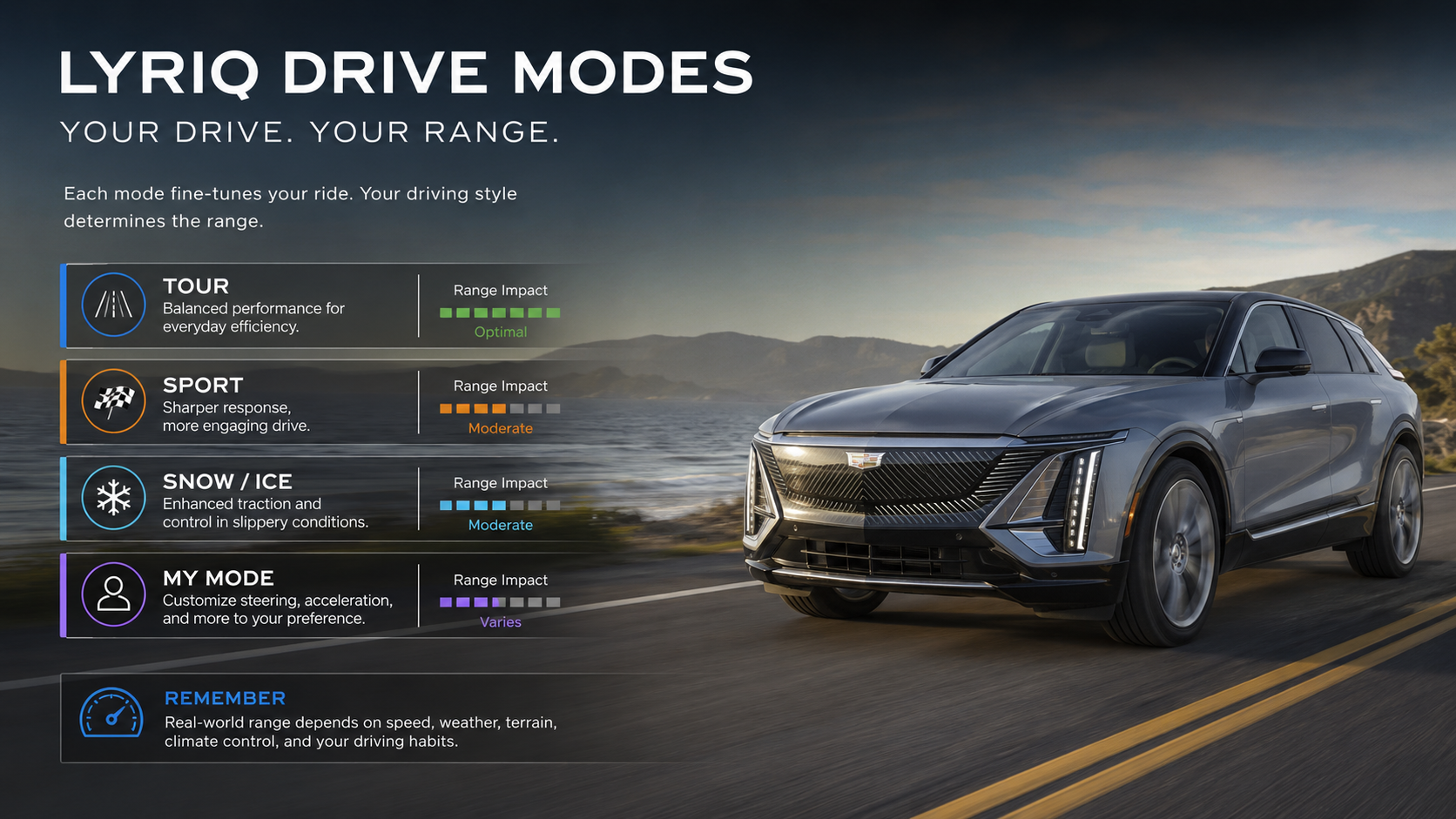
Do Cadillac LYRIQ Driving Modes Change Range or Battery Use? The practical answer is yes for real-world energy consumption, but no for fixed or separately advertised range ratings.
Selecting Tour, Sport, Snow/Ice, or My Mode doesn’t change the physical size of the battery. Nor does Cadillac assign each regular mode its own official driving range. Instead, the modes alter characteristics such as accelerator response, steering effort, suspension behavior and, on some versions, electric all-wheel-drive operation. Those changes can influence how much energy the vehicle uses, especially when they encourage quicker acceleration or prioritize traction.
There is one particularly important exception: Cadillac explicitly warns that the available Velocity Max performance feature depletes the battery faster than normal drive modes. This guide explains how each setting works, why your displayed range may change and which choices make the most sense when conserving battery power matters.
The direct answer: Driving modes don’t provide separate official ranges
Cadillac publishes LYRIQ range estimates according to the vehicle’s configuration, such as rear-wheel drive versus dual-motor all-wheel drive. It does not publish separate ratings for driving the same vehicle in Tour, Sport, Snow/Ice or My Mode. For example, Cadillac’s US specifications distinguish the LYRIQ’s range by powertrain configuration rather than by the selected drive mode.
That distinction matters. A vehicle’s rated range and its real-world range aren’t the same thing:
- Rated range is the standardized estimate associated with a particular vehicle configuration.
- Real-world range is how far that vehicle travels under its actual conditions and energy consumption.
- Displayed range is the vehicle’s changing estimate of how far it can travel with its remaining charge.
Changing modes doesn’t give the battery a larger or smaller usable capacity. It may, however, affect acceleration behavior, traction management and the way the driver operates the vehicle. Those differences can raise or lower actual consumption over a journey.
Cadillac’s 2025 LYRIQ manual says its range display is calculated using recent driving habits, operating conditions and climate-control use. It also identifies aggressive acceleration and braking, heavy HVAC use, battery preconditioning and performance modes as factors that can affect the estimated range.
Do the driving modes in Cadillac LYRIQ offer different ranges or battery usages?
The regular modes don’t contain predetermined battery-use limits. You won’t get one fixed number of miles in Tour and another guaranteed number in Sport.
Think of the modes as different control calibrations. The battery still supplies the energy, but the accelerator, steering, suspension and traction systems may respond differently. A more sensitive accelerator can make rapid power delivery easier, while a traction-focused mode may change how an all-wheel-drive model manages its motors.
The resulting battery consumption depends on what happens after the mode is selected.
A driver who uses Sport mode but maintains a steady speed and accelerates gently may see little difference from Tour. Another driver who repeatedly uses the sharper response and stronger acceleration may consume noticeably more energy. The mode creates the conditions for a different experience; the driver and route determine much of the final efficiency.
How each Cadillac LYRIQ mode can affect range
Mode availability varies by model year, trim, region and installed equipment. The 2025 LYRIQ owner’s manual identifies Tour, Sport, Snow/Ice and My Mode, while newer or performance-oriented vehicles may also offer features such as Velocity Max or V-Mode. Owners should check the manual associated with their exact vehicle.
| Driving mode or feature | What it changes | Separate published range? | Likely effect on battery use |
|---|---|---|---|
| Tour | Balanced comfort and handling for normal driving | Not published | Usually the best baseline for ordinary efficiency |
| Sport | Pedal response, steering and other performance settings | Not published | Can increase consumption when the extra responsiveness is used aggressively |
| Snow/Ice | Pedal tuning, traction behavior, steering and eAWD settings where equipped | Not published | Varies; weather and road resistance are often more significant than the mode itself |
| My Mode | Driver-selected acceleration, steering, braking and other settings | Not published | Depends on the selected configuration and driving style |
| Velocity Max | Unlocks additional horsepower and torque on equipped vehicles | Not published as an everyday mode range | Cadillac states that it depletes the battery faster |
Tour mode: The everyday baseline
Cadillac describes Tour as the mode for normal city and highway driving. It balances comfort and handling and provides a smooth everyday driving experience.
Tour is the most sensible starting point when trying to conserve energy, but Cadillac doesn’t label it as a dedicated “Eco” mode or promise that it will always produce the longest range. Its main advantage is predictable, balanced calibration rather than a special restriction on battery output.
For a routine commute, Tour can make efficient driving easier because there is less emphasis on performance-oriented responses. Smooth acceleration, moderate speed and limited unnecessary braking will still matter more than the word shown on the mode screen.
Sport mode: More responsive, but not automatically inefficient
Sport mode is designed to provide a more controlled and responsive driving experience on dry pavement. According to the LYRIQ manual, it can modify accelerator-pedal tuning, steering effort, electric-vehicle sound enhancement, adaptive cruise control behavior and suspension tuning when the relevant equipment is present.
The accelerator’s sharper feel does not mean the vehicle constantly draws maximum power. At a steady cruise, energy demand is primarily determined by speed, aerodynamic resistance, road gradient and accessory use.
Sport can still lead to higher consumption because it makes brisk acceleration more accessible and may encourage a more energetic driving style. The US Department of Energy notes that rapid acceleration reduces an electric vehicle’s range compared with gradual acceleration.
The important distinction is that Sport mode enables a more responsive experience; it doesn’t force the driver to use all the available performance continuously.
Snow/Ice mode: Traction comes before maximum efficiency
Snow/Ice mode changes pedal tuning to help manage traction on slippery surfaces. On applicable LYRIQ versions, it also modifies steering and electric all-wheel-drive behavior. Cadillac cautions that its softened response can compromise acceleration on dry pavement, which is why it should be reserved for suitable conditions.
It would be misleading to assign Snow/Ice mode a universal range penalty. Cold batteries, cabin heating, snow-covered roads, winter tires and increased rolling resistance can all affect energy use. In those circumstances, the weather and surface conditions are likely to have a larger impact than the mode selection alone.
Snow/Ice should therefore be chosen for control and safety, not as a method of saving battery. A slightly different power-distribution strategy is a reasonable trade-off when the road is slippery.
Cadillac also advises against using One-Pedal Driving on snowy or icy roads. The owner’s manual recommends selecting Snow/Ice mode while turning One-Pedal Driving off when conditions are slippery.
My Mode: Battery use depends on your settings
My Mode allows the driver to build a personalized everyday configuration. On the 2025 LYRIQ, available adjustments may include:
- Acceleration feel: Relaxed, Tour or Sport
- Brake feel: Tour or Sport
- Steering: Tour or Sport
- Suspension: Tour or Sport
- Motor sound: Tour or Sport
The precise options depend on the vehicle’s equipment.
Because My Mode is customizable, it has no single efficiency profile. A configuration using Relaxed acceleration with Tour steering could support calm, progressive driving. A setup with Sport acceleration and other performance-oriented preferences may make higher energy consumption more likely when driven enthusiastically.
Brake Feel also shouldn’t be confused with the separate One-Pedal Driving setting. My Mode’s brake-pedal response is a personalization feature, while One-Pedal Driving controls how strongly the vehicle decelerates as the accelerator is released.
Velocity Max: The confirmed high-consumption exception
On properly equipped Cadillac EVs, Velocity Max unlocks additional horsepower and torque for stronger acceleration. Cadillac specifically warns that using it depletes the battery faster than normal driving modes and tells drivers to preserve enough remaining range to reach their destination.
That makes Velocity Max different from the more nuanced Tour-versus-Sport discussion. Cadillac directly confirms increased battery depletion rather than merely describing a change in pedal feel.
Velocity Max is intended for short periods when maximum performance is wanted. It isn’t the appropriate choice for stretching the remaining charge during a long journey. Availability depends on the vehicle, so the presence of a V button or a Velocity Max option in the Drive Mode app should be confirmed before assuming a particular LYRIQ has it.
Why the range display may change after selecting a mode
The range number on the instrument panel is an estimate, not a measurement of battery capacity. Cadillac calls attention to several inputs used by the estimate, including recent driving habits, current conditions and HVAC consumption.
Suppose the vehicle has recently completed several gentle urban journeys. Its range estimate may reflect relatively low energy consumption. If the next trip includes high-speed driving, repeated hard acceleration and strong cabin heating, the estimate may begin falling faster than expected.
A mode change can be part of that pattern, particularly when a performance mode is selected, but it may not be the only reason the number moves. The estimator is also reacting to:
- Outside temperature
- Cabin heating or air conditioning
- Vehicle speed
- Hills and elevation changes
- Payload or towing
- Recent energy consumption
- Battery temperature and preconditioning
- Acceleration and braking habits
Cadillac says the estimate can rise or fall as climate-control energy consumption changes. The Department of Energy likewise advises EV drivers to account for heating, cooling, hilly terrain and heavy loads when planning usable range.
Which LYRIQ mode uses the least battery?
There is no official Cadillac chart naming one regular mode as the guaranteed lowest-consumption setting. For normal journeys, Tour is the most practical efficiency baseline because it is calibrated for balanced everyday driving rather than maximum performance or slippery-road traction.
That recommendation has limits. A careful driver in Sport may use less energy than an impatient driver in Tour. Similarly, changing to My Mode with Relaxed acceleration may make smooth inputs easier, but it doesn’t override the effects of high speed, cold weather or intensive cabin heating.
For the longest practical range:
- Begin with Tour or a calm My Mode configuration.
- Accelerate progressively rather than using repeated bursts of power.
- Maintain a moderate, steady speed where traffic and limits permit.
- Use climate control thoughtfully without compromising visibility or comfort.
- Reserve Snow/Ice for slippery conditions and Velocity Max for brief performance use.
- Watch average efficiency over an entire trip rather than judging consumption from a momentary power reading.
One-Pedal Driving, regeneration and range
One-Pedal Driving is related to energy efficiency, but it isn’t one of the LYRIQ’s principal Tour, Sport, Snow/Ice or My Mode selections. It is a separate feature that controls deceleration when the driver lifts off the accelerator.
Regenerative braking uses the electric motor to slow the vehicle and return some of its kinetic energy to the battery. Cadillac’s Regen On Demand paddle provides another way to request regenerative deceleration.
Regeneration cannot recover all the energy previously used to accelerate. Avoiding unnecessary acceleration and deceleration remains more efficient than repeatedly speeding up and trying to capture the energy again.
The amount of regeneration may also be limited when the battery is near full or its temperature is extremely hot or cold. Under those conditions, the vehicle may blend in its conventional friction brakes to provide consistent deceleration.
How to compare mode efficiency in your own LYRIQ
A controlled personal test can reveal more than watching the estimated range change after one trip.
Choose a repeatable route of reasonable length. Use the same starting point, similar traffic conditions and approximately the same cabin-temperature setting. Begin each test with a similar state of charge and, as far as possible, a similarly warmed or cooled battery.
Reset the trip information, drive the route in Tour and record the average energy efficiency, usually shown as miles per kilowatt-hour or its regional equivalent. Repeat the route in Sport or your preferred My Mode configuration on another comparable day.
Run each test more than once. A single journey can be distorted by wind, congestion, temperature, elevation or an unusually long period of cabin conditioning.
Don’t use Snow/Ice on dry roads merely to complete the comparison. That mode is intended for slippery surfaces, and Cadillac notes that it can compromise acceleration on dry asphalt. Likewise, testing Velocity Max on public roads solely to measure consumption would be inappropriate; follow all traffic laws and reserve performance testing for a safe, lawful environment.
Common misunderstandings about LYRIQ drive modes
“Sport mode permanently reduces the battery’s capacity”
It doesn’t. The battery doesn’t become smaller when Sport is selected. Sport changes vehicle responses, and using those responses aggressively can increase the rate at which stored energy is consumed.
“Snow/Ice mode gives extra winter range”
Its purpose is traction management, not range extension. Any winter efficiency result will be influenced by temperature, heating demand and road conditions as well as the selected mode.
“The displayed range should remain fixed at a given charge percentage”
The displayed number is adaptive. Cadillac says it reflects recent habits, climate settings and present operating conditions, so two journeys beginning at the same charge percentage can show different estimated ranges.
“Stronger regenerative braking always means greater efficiency”
Regeneration can recover energy, but abrupt slowing followed by renewed acceleration still creates losses. Smoothly maintaining momentum is often preferable when traffic and safety permit. Regenerative performance can also be restricted by battery temperature or a high state of charge.
“Every Cadillac LYRIQ has the same modes”
Mode availability and the systems affected by each mode depend on model year, trim, market and optional equipment. Performance variants can have controls that standard models do not.
FAQs
Do the driving modes in Cadillac LYRIQ offer different ranges or battery usages?
They don’t provide separate fixed range ratings. Tour, Sport, Snow/Ice and My Mode change vehicle responses rather than battery capacity. Real-world battery use can differ because accelerator tuning, traction behavior and driving style affect energy demand. Velocity Max is the clearest exception: Cadillac explicitly says it depletes the battery faster than normal modes.
Does Sport mode reduce Cadillac LYRIQ range?
Sport mode can reduce real-world range when its sharper accelerator response leads to frequent hard acceleration. It doesn’t automatically create a fixed range reduction, however. A steady, gentle drive in Sport may use a similar amount of energy to Tour, while an aggressive drive in either mode will consume more.
Is Tour mode the LYRIQ’s Eco mode?
Cadillac describes Tour as the normal mode for balanced city and highway driving, not as a dedicated Eco mode. It is still the logical everyday choice when efficiency is a priority because it avoids the performance emphasis of Sport and the specialized traction calibration of Snow/Ice.
Does Snow/Ice mode use more battery?
It may change energy consumption by modifying pedal tuning and, where applicable, electric all-wheel-drive behavior. Cadillac doesn’t publish a fixed battery penalty for it. In genuine winter conditions, cold temperatures, cabin heating and snow-covered roads are likely to be major influences on range.
Can My Mode be configured to save battery?
A My Mode configuration with Relaxed acceleration may help a driver apply power more smoothly, but Cadillac doesn’t identify any My Mode combination as a certified efficiency setting. Speed, climate use, terrain and driving technique still determine much of the result.
Does One-Pedal Driving increase LYRIQ range?
It can recover some energy during deceleration by using regenerative braking. Its benefit depends on the journey and the driver. Avoiding unnecessary changes in speed is generally more efficient than accelerating hard and relying on regeneration afterward. Cadillac advises against using One-Pedal Driving on wet, snowy or icy roads.
Why did my estimated range drop after switching to Sport?
The estimator may be responding to recent energy use, performance-mode operation, climate settings or a combination of factors. Cadillac says hard acceleration, excessive HVAC use and performance modes can affect its range estimates. The change doesn’t necessarily mean the battery has lost capacity.
Conclusion
So, do the driving modes in Cadillac LYRIQ offer different ranges or battery usages? They can produce different real-world consumption, but the regular modes do not come with separate fixed range allowances.
Tour is the best general-purpose baseline for drivers prioritizing predictable efficiency. Sport can consume more when its added responsiveness is used aggressively. Snow/Ice prioritizes traction, while My Mode’s effect depends on how it is configured. On equipped vehicles, Velocity Max is the one feature Cadillac expressly says will drain the battery faster.
The most useful number to monitor is your average energy efficiency over comparable journeys—not a single change in the dashboard’s range estimate. Driving speed, temperature, climate use, terrain and accelerator inputs usually tell more of the story than the mode name alone.
Read also Crew CloudySocial Com: What It Is and What to Verify
