

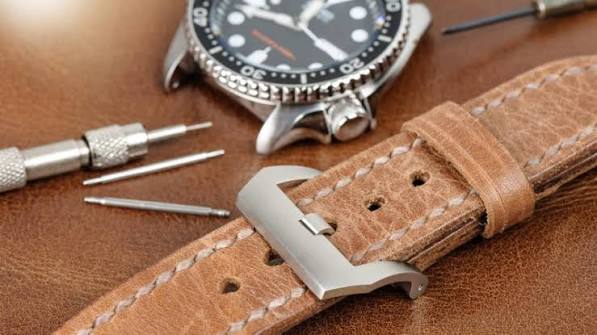
Watches are often taken out of daily use long before their movements fail. A cracked leather strap, stretched hole or unreliable buckle is enough to make an otherwise dependable watch feel risky. The owner starts choosing another piece, and the old favourite gradually moves to the back of a drawer.
That outcome is avoidable when the problem is limited to the strap or its fittings. Inspecting the worn parts, taking accurate measurements and choosing a replacement for the way the watch is used can bring it back into regular rotation. The job is small, but it affects comfort, security and appearance every hour the watch is worn.
Read also El Despeñadero: The Four-Century Estate Behind Cacerías Ibéricas
Signs that a strap should be retired
Leather gives several warnings. Cracks may develop around the adjustment holes, the lining can separate, and the section near the spring bar may become thin or distorted. Surface creasing is normal, but deep splits or loose stitching near a load-bearing point should not be ignored.
Fabric can fray at the holes, edges or keepers. Rubber may split where it bends repeatedly, become sticky or lose its shape. Metal bracelets can develop excessive play, damaged links or a clasp that no longer closes reliably. Dirt can make wear harder to see, so the strap should be inspected in good light after suitable cleaning.
Confirm that the problem is limited to the strap
Before ordering anything, check the watch head. The lugs should appear sound, the crown should work normally and the case should not contain visible moisture. If the watch has stopped, loses significant time or has an unknown service history, a watchmaker can advise whether it needs attention beyond the external parts.
When the case and movement are in working order, a Watch band replacement can address the component most exposed to sweat, movement and daily knocks. Watch Obsession carries straps and related accessories across leather, nylon, fabric, rubber and metal categories, giving owners a way to choose for real use rather than simply copying the worn item.
Measure width length and buckle end
The first measurement is the internal distance between the lugs. Take it where the strap connects to the case. Do not use case diameter as a guide. A 40mm watch might use a 20mm, 21mm or another width depending on its design.
The replacement must match that gap. A narrow strap leaves movement and visible space, while an oversized one can be pinched or damaged during installation. Curved-end and integrated designs may require a model-specific option even when the nominal width appears correct.
Next, compare length. Note the long and short sides of a comfortable strap, not just the total measurement. This helps keep the buckle centred beneath the wrist. If an original signed buckle or deployment clasp will be transferred, measure the strap at that end as well. Taper means the lug and buckle widths can differ.
Choose for the reason the old strap failed
Replacing like for like is easy, but it may repeat the same problem. Someone who damaged leather through regular exposure to rain may be better served by a suitable water-resistant material. A person who found a steel bracelet heavy could move to fabric or leather. A strap that was always too long should be replaced with a shorter version rather than another standard length.
Use also determines appearance. Smooth leather works well for office wear and formal occasions. Grained or vintage-style leather feels more relaxed. Nylon and canvas suit field watches, casual clothing and warm commutes. Rubber fits many sports and dive watches, but the case’s own water-resistance guidance still controls whether the complete watch can be worn in water.
Watch Obsession lists brands including Hirsch, RIOS1931, Morellato, Di Modell, Erika’s Originals and its own range. Each manufacturer has its own materials and construction, so checking the individual product specification is more useful than assuming all straps in one category behave the same way.
Do not overlook spring bars and clasps
A strong new strap is only secure if the fittings are sound. Spring bars are small and inexpensive, yet they carry the watch between the lugs. Bent, corroded or weak bars should be replaced with the correct size. The bar must click fully into both lug holes.
Quick-release systems make compatible straps easier to remove by using a small lever on the underside. Standard bars need a suitable tool. Both can be secure when correctly fitted. After installation, pull gently near each lug and inspect the gap to make sure the bar has not caught against the edge instead of entering the hole.
Clasps and pin buckles also need checking. The pin should move freely and pass cleanly through the selected hole. Keepers should hold the strap tail without squeezing or allowing it to flap. A deployment clasp must match the strap thickness and width, not simply its colour.
Give the repaired watch a trial day
Wear the watch at home before relying on it during a commute or long day out. Move the wrist normally and check for rubbing, tipping or loosening. If the case slides too far, adjust the fit rather than fastening it painfully tight. New leather may soften with wear, but it should not feel as though it is cutting into the wrist.
The old strap may still be worth keeping if it is original to the watch, particularly when it has a signed buckle. Store it dry and labelled. A badly degraded strap should not be worn for sentiment alone, but it can remain part of the watch’s history.
A favourite watch does not need to be replaced because the part designed to wear out has reached the end of its life. Dealing with the strap promptly protects the watch from a fall and removes the discomfort that stopped it being worn. It is one of the simplest ways to recover value from something already owned.
