

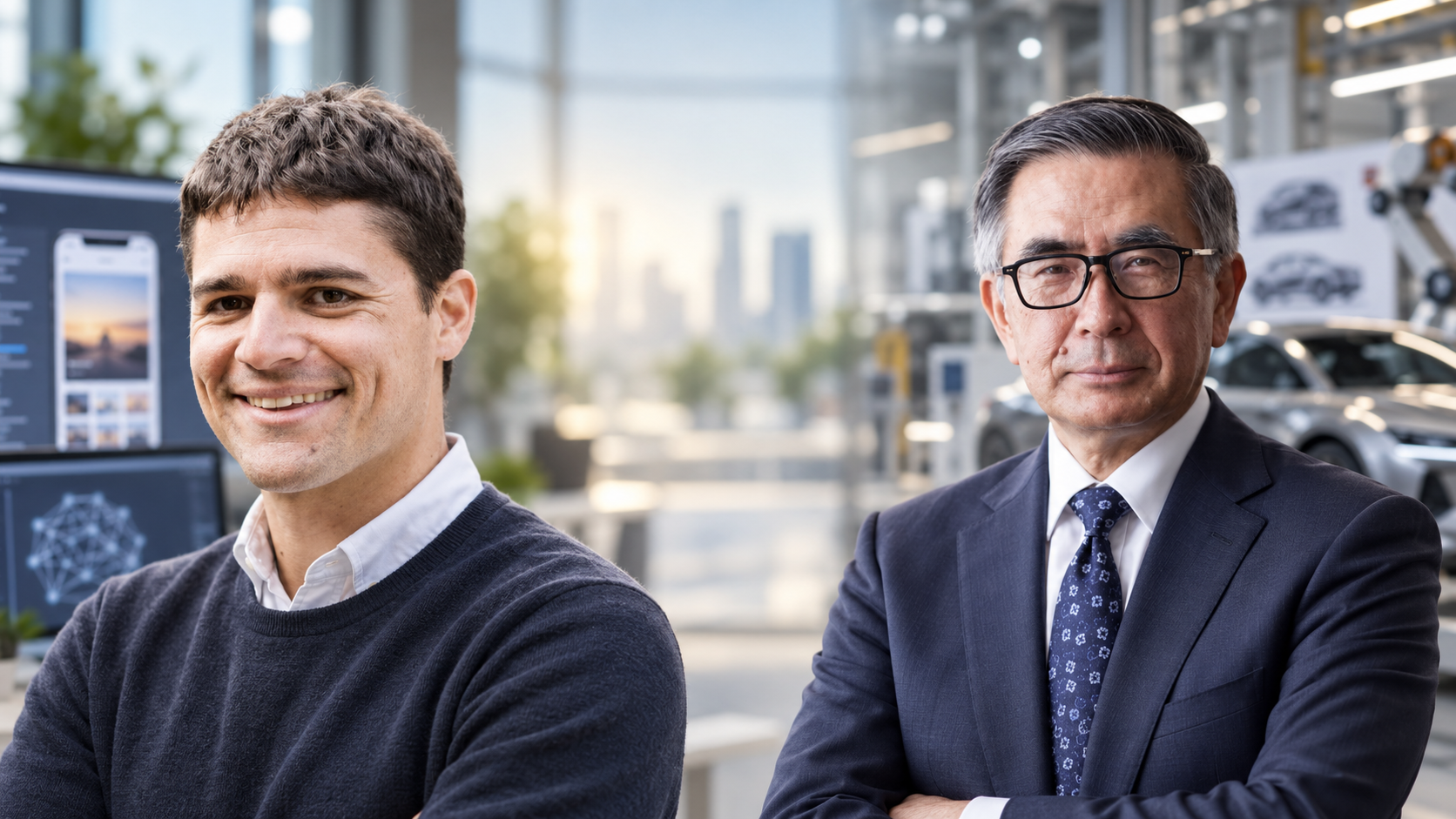
Mike Krieger and Toshihiro Suzuki are prominent business figures whose careers developed in very different industries but provide an interesting look at how leadership, innovation, product development, and long-term thinking can shape successful organizations. Mike Krieger became internationally recognized through software, social media, and artificial intelligence, while Toshihiro Suzuki built his career within one of Japan’s most established mobility companies. Their professional paths are not known to involve a direct business partnership, yet looking at them together provides a useful comparison between the rapid development cycles of digital technology and the complex, long-term demands of global automobile manufacturing. Krieger’s career demonstrates how simple digital products can grow into platforms serving enormous audiences, whereas Suzuki’s career illustrates how an established industrial company can continue evolving while serving customers across different markets, economic conditions, and transportation needs.
| Quick Bio | Mike Krieger | Toshihiro Suzuki |
|---|---|---|
| Profession | Software engineer, entrepreneur, product leader | Business executive |
| Best Known For | Co-founding Instagram | Leading Suzuki Motor Corporation |
| Main Industry | Technology, software and artificial intelligence | Automotive and mobility |
| Background | Brazilian-born, educated at Stanford University | Japanese automotive executive |
| Major Organization | Instagram, Artifact, Anthropic | Suzuki Motor Corporation |
| Current/Recent Role | Building experimental products with Anthropic Labs | Representative Director and President of Suzuki Motor Corporation |
| Leadership Focus | Product design, engineering, software and AI | Mobility, manufacturing, global growth and customer-focused vehicles |
Who Are Mike Krieger and Toshihiro Suzuki?
Understanding Mike Krieger and Toshihiro Suzuki begins with recognizing that they represent two very different business environments. Krieger’s professional identity was established in Silicon Valley, where software products can move from an early idea to millions of users in a relatively short period. His work has consistently combined engineering with product thinking, from the early days of Instagram to personalized news and, more recently, artificial intelligence products. Suzuki’s career developed within a global manufacturing organization where product decisions involve engineering, factories, suppliers, safety requirements, distribution networks, investment planning, and years of development. The contrast makes their careers particularly interesting because both have worked with technology, but the meaning of technological innovation is quite different in their respective industries.
There is no well-established public record indicating that the two executives have worked together on a major project or have a direct professional relationship. Their importance instead comes from what their separate careers reveal about modern leadership. Krieger represents a generation of technology founders who helped make mobile software a central part of everyday life, while Suzuki represents the leadership of a century-old company adapting to changing expectations around mobility, efficiency, electrification, manufacturing, and international growth. Seen from this perspective, their careers provide two different answers to the same broad business question: how can an organization keep creating useful products while technology and customer expectations continue to change?
Mike Krieger: From Stanford to Instagram and Artificial Intelligence
Mike Krieger is a Brazilian-born software engineer and entrepreneur who became best known as the co-founder of Instagram. A native of São Paulo, Brazil, Krieger moved to California to attend Stanford University, where he studied Symbolic Systems with a focus on human-computer interaction. Stanford’s description of his early career notes that he worked in product and software roles before eventually teaming up with fellow Stanford alumnus Kevin Systrom. Their work together developed from an earlier project called Burbn into the simpler photo-sharing application that became Instagram. The decision to simplify the product was important because Instagram concentrated on making mobile photography and sharing fast, attractive, and easy to understand rather than trying to include every possible social-networking feature.
Instagram launched in 2010 and quickly became one of the most recognizable mobile applications of its era. While Systrom became highly visible as the company’s chief executive, Krieger was central to the technical side of the business and served as its chief technology officer. His responsibilities extended beyond writing software because scaling a rapidly growing social platform required engineering architecture, product judgment, hiring, team development, and continuous improvements to reliability. Anthropic later credited Krieger with helping scale Instagram to more than one billion users and growing its engineering organization to more than 450 people. That experience gave him an unusually broad background covering hands-on engineering, product design, organizational management, and the challenges that emerge when a relatively small startup becomes a global consumer technology platform.
A particularly important part of Krieger’s career is his emphasis on product simplicity. Instagram succeeded during a period when smartphones were transforming how people captured and shared everyday experiences, yet the product did not initially attempt to imitate every function of traditional social networks. Instead, its founders concentrated on common problems surrounding mobile photo sharing, including speed, appearance, and ease of distribution. That approach reflects a wider principle that has appeared throughout Krieger’s career: useful technology does not necessarily become more valuable by becoming more complicated. Successful products often emerge when technical sophistication is hidden behind an experience that feels straightforward to the person using it.
Mike Krieger After Instagram
Krieger and Systrom left Instagram in 2018, but Krieger eventually returned to startup building. The two founders created Artifact, a personalized news application that used machine learning to recommend articles according to users’ interests. The project represented a shift from social photography toward information discovery and personalization. Although Artifact did not achieve Instagram’s scale, it provided another example of Krieger’s interest in combining machine learning with consumer-focused product design. Anthropic’s 2024 announcement about Krieger noted that he had spent the previous three years building Artifact before its acquisition by Yahoo.
Krieger’s next major move placed him directly inside the rapidly expanding artificial intelligence industry. In May 2024, Anthropic announced that he had joined the company as Chief Product Officer, responsible for product engineering, product management, and product design. This role connected his previous experience building consumer technology with the development of Claude and other AI experiences. In January 2026, Anthropic announced an expansion of Anthropic Labs, an internal team focused on experimental products built around emerging Claude capabilities, and said Krieger was joining Labs to build alongside Ben Mann. Anthropic simultaneously announced that Ami Vora would lead its broader Product organization. The transition illustrates how Krieger’s career has continued moving toward emerging technologies where the final shape of products is still being discovered through rapid experimentation.
His move into AI is also a natural continuation of his earlier work rather than a complete change of direction. Instagram required understanding how people interacted with mobile interfaces and social information, Artifact explored personalized content discovery, and AI products require designers and engineers to determine how increasingly capable models can be turned into experiences that ordinary people can actually use. Technical capability by itself rarely guarantees a successful product. The interface, reliability, context, trust, and clarity of what the technology can accomplish often determine whether users adopt it. Krieger’s background in human-computer interaction and large-scale consumer products therefore remains highly relevant as artificial intelligence moves beyond research demonstrations and becomes integrated into everyday work and creative activities.
Toshihiro Suzuki: Leadership at Suzuki Motor Corporation
Toshihiro Suzuki represents a very different form of technology leadership. Born on March 1, 1959, he joined Suzuki Motor Corporation in January 1994 and accumulated experience across manufacturing, product planning, global marketing, and corporate management. Suzuki’s official shareholder materials show that he served as plant manager of the Iwata Plant, spent time as a resident officer at General Motors in the United States, led product-planning activities, became a director in 2003, and later moved through increasingly senior executive positions. He became Representative Director and President in June 2015 and has served as Chairman of the Board of Directors while continuing as Representative Director and President since 2021.
His progression through manufacturing and product-planning positions matters because an automotive executive must balance a much wider physical system than a software product leader typically encounters. Vehicle development combines design, engineering, safety, regulations, manufacturing capacity, procurement, logistics, dealership networks, maintenance, pricing, and long-term investment. Decisions may require billions in capital and can affect factories and product programs for many years. Toshihiro Suzuki’s career therefore illustrates leadership built through extensive operational knowledge rather than the startup model of creating a new company around a single rapidly scaling product.
As of June 25, 2026, Suzuki Motor Corporation officially lists Toshihiro Suzuki as Representative Director and President, as well as Chairman of its Board of Directors. His leadership arrives at an important moment for the automotive sector as manufacturers respond to electrification, changing environmental requirements, software integration, alternative fuels, and shifting consumer preferences. Suzuki’s strategy remains closely associated with producing practical and efficient vehicles rather than simply pursuing size or technological complexity. The company’s president has emphasized its long-standing philosophy of creating smaller and lighter products that use resources efficiently while delivering the functions customers actually need.
Toshihiro Suzuki and the Importance of India
One of the most important elements of Toshihiro Suzuki’s leadership is the company’s position in India. Suzuki has spent decades developing its presence in the Indian automobile market through Maruti Suzuki, and India continues to play a major role in the company’s manufacturing and growth strategy. In July 2026, Suzuki announced the inauguration of a new automobile manufacturing facility in Kharkhoda, Haryana. According to the company, the start of operations at this facility brought Suzuki’s annual automobile production capacity in India to approximately 2.65 million units, with additional capacity expansion planned as the company works toward a production system capable of four million units annually in the 2030s.
This expansion demonstrates a key difference between automotive growth and digital-platform growth. A software service can sometimes add users through additional computing infrastructure and application development, but automobile expansion requires land, factories, machinery, suppliers, trained workers, logistics networks, dealerships, and large amounts of capital. Toshihiro Suzuki therefore has to consider both immediate market conditions and demand many years into the future. The company’s continuing investment in India reflects confidence in the country’s long-term mobility demand as well as its importance as a manufacturing and export base.
Suzuki is also preparing for technological change rather than relying exclusively on its traditional strengths. The global automotive sector is exploring battery-electric vehicles, hybrids, alternative fuels, advanced batteries, connected technology, and other approaches to lowering environmental impact. In March 2026, for example, Suzuki Motor Corporation announced an agreement to acquire an all-solid-state lithium-ion battery business from Kanadevia Corporation, including technology related to development, design, and sales. Such investments illustrate how the company is attempting to combine its established expertise in compact, resource-efficient transportation with technologies that may shape future vehicles and mobility systems.
Mike Krieger and Toshihiro Suzuki: Different Approaches to Innovation
Mike Krieger and Toshihiro Suzuki demonstrate that innovation does not follow a single formula. Krieger built his reputation in an environment where teams can create prototypes quickly, release products to users, examine feedback, and change direction within weeks or even days. Software development encourages experimentation because many improvements can be distributed digitally without replacing a physical object already owned by the customer. Krieger’s journey from Instagram to Artifact and Anthropic reflects this experimental culture, with each stage exploring a different way for people to interact with digital information and increasingly capable computing systems.
Suzuki operates under very different constraints. A vehicle cannot be updated or replaced as casually as a mobile application. Automotive products require extensive testing, regulatory approval, manufacturing preparation, supply-chain coordination, quality control, and physical distribution. As a result, innovation must often be planned on a longer timeline while still responding to fast-changing technology. The challenge is not simply to introduce new technology but to make that technology affordable, reliable, manufacturable, and appropriate for customers in very different countries.
Despite these differences, their careers share an important idea: technology is most valuable when it solves practical problems. Krieger’s early work on Instagram centered on making mobile photo sharing easier and more enjoyable. Suzuki’s corporate philosophy emphasizes practical vehicles that are compact, efficient, and suited to customers’ real transportation requirements. Neither approach treats complexity as an achievement by itself. Instead, both demonstrate how sophisticated engineering can create greater value when the final product feels accessible and useful.
Leadership Lessons From Mike Krieger and Toshihiro Suzuki
The careers of Mike Krieger and Toshihiro Suzuki offer several lessons for entrepreneurs, managers, engineers, and business students. The first is that understanding customers remains essential regardless of industry. Instagram’s growth was supported by an intuitive product experience built around behaviors people were already adopting on smartphones. Suzuki’s success in markets such as India has similarly depended on understanding transportation needs, affordability, efficiency, local market conditions, and the practical requirements of customers. Companies can possess advanced technology and still struggle if they lose sight of the problems their users are actually trying to solve.
Another lesson is the importance of adapting without discarding existing strengths. Krieger did not remain exclusively associated with photo-sharing technology after Instagram; he moved toward personalized information and then frontier AI products. His underlying strengths in engineering, human-computer interaction, product design, and scaling remained valuable even as the technology changed. Toshihiro Suzuki faces a similar challenge on a much larger industrial scale. Suzuki Motor Corporation must participate in a changing mobility landscape while preserving the efficiency, manufacturing expertise, compact design philosophy, and market knowledge that have historically differentiated the company.
Scale is another shared theme. Krieger experienced scale primarily through digital infrastructure and global software audiences. Suzuki manages scale through physical manufacturing, international operations, suppliers, employees, dealerships, and major capital investment. The operational details differ enormously, but both forms of scale demand disciplined systems. A product that works for a small early audience may fail under the demands of hundreds of millions of users, just as a successful vehicle concept can fail commercially if a company cannot manufacture it reliably, price it competitively, and deliver it efficiently.
Technology, Mobility, and the Future
The future chapters of Mike Krieger and Toshihiro Suzuki are likely to develop around two of the most significant areas of technological change: artificial intelligence and mobility. Krieger’s work with Anthropic Labs places him in an environment focused on finding useful product experiences around increasingly capable AI systems. Anthropic described Labs as a group intended to incubate experimental products at the frontier of Claude’s capabilities, meaning Krieger’s role once again involves exploring what a new technological platform can become before all of its most valuable applications are obvious.
Toshihiro Suzuki faces an equally significant transformation in transportation. Automakers are deciding how quickly to adopt different powertrain technologies, how to manage battery costs and resources, how to maintain affordable mobility, and where future demand will emerge. Suzuki’s extensive position in India adds another dimension because transportation solutions that succeed in wealthy markets may not automatically fit the needs of rapidly developing economies. The ability to balance environmental progress, affordability, manufacturing capacity, and everyday usefulness will therefore remain central to the company’s long-term strategy.
What Makes Mike Krieger and Toshihiro Suzuki Worth Studying?
Mike Krieger and Toshihiro Suzuki are worth studying precisely because their careers are not identical. Business discussions sometimes treat innovation as though every company should imitate fast-moving technology startups, but manufacturing, transportation, and other capital-intensive industries operate according to different realities. Krieger shows the advantages of experimentation, simplicity, rapid iteration, technical talent, and close attention to user experience. Suzuki demonstrates the importance of operational experience, manufacturing discipline, market knowledge, long-term planning, and adapting an established global organization to technological change.
Together, their stories illustrate a broader principle about leadership: successful executives must understand the systems in which they operate. Krieger’s environment rewards the ability to recognize emerging digital behaviors and convert technological possibilities into intuitive products. Suzuki’s environment requires coordinating complex physical operations while anticipating long-term changes in transportation and consumer demand. Neither path is universally better. Each demonstrates how leadership works when strategy is matched to the realities of an industry.
Conclusion
Mike Krieger and Toshihiro Suzuki represent two distinctive paths through modern technology and business. Krieger moved from human-computer interaction and software engineering to co-founding Instagram, building Artifact, joining Anthropic as Chief Product Officer, and eventually moving into Anthropic Labs to develop experimental AI products. Suzuki progressed through manufacturing, product planning, marketing, and corporate leadership before becoming President of Suzuki Motor Corporation, where he continues overseeing a global mobility business adapting to new technologies and expanding in strategically important markets. Their careers developed independently, and there is no established major business partnership connecting them, but studying their achievements together provides a valuable comparison between digital innovation and industrial transformation.
Their experiences also demonstrate that lasting innovation is rarely about technology alone. Successful products must address genuine needs, remain understandable to customers, operate effectively at scale, and adapt as markets change. Whether that product is a mobile application used around the world or a vehicle produced through an international manufacturing network, strong leadership ultimately requires combining technical possibilities with practical value. That shared principle is what makes the careers of Mike Krieger and Toshihiro Suzuki relevant to anyone interested in entrepreneurship, product development, technology, global business, or the future of innovation.
FAQs About Mike Krieger and Toshihiro Suzuki
Who is Mike Krieger?
Mike Krieger is a Brazilian-born software engineer, entrepreneur, and product leader best known for co-founding Instagram with Kevin Systrom. He served as Instagram’s Chief Technology Officer, later co-founded the personalized news application Artifact, joined Anthropic as Chief Product Officer in 2024, and moved into Anthropic Labs in 2026 to work on experimental AI products.
Who is Toshihiro Suzuki?
Toshihiro Suzuki is a Japanese business executive and the Representative Director and President of Suzuki Motor Corporation. He joined the company in 1994, held leadership positions in manufacturing, product planning and corporate management, and became president in 2015. Suzuki’s 2026 corporate records continue to list him as Representative Director and President and Chairman of the Board of Directors.
Are Mike Krieger and Toshihiro Suzuki related?
There is no established evidence that Mike Krieger and Toshihiro Suzuki are related. They come from different backgrounds and have built careers in separate industries, with Krieger primarily associated with software and artificial intelligence and Suzuki associated with automotive manufacturing and mobility.
Did Mike Krieger and Toshihiro Suzuki work together?
No major professional collaboration between Mike Krieger and Toshihiro Suzuki has been publicly established. Their careers are better understood as separate examples of leadership and innovation in technology and automotive manufacturing.
What is Mike Krieger famous for?
Mike Krieger is most famous for co-founding Instagram and serving as the company’s Chief Technology Officer. He helped develop and scale the platform before later working on Artifact and artificial intelligence products at Anthropic.
What is Toshihiro Suzuki famous for?
Toshihiro Suzuki is best known for leading Suzuki Motor Corporation. His career includes senior responsibilities in manufacturing, product planning, marketing, corporate strategy, and international automotive operations.
What do Mike Krieger and Toshihiro Suzuki have in common?
Although they work in very different industries, both have been involved in creating and improving products for large international customer bases. Their careers also demonstrate an emphasis on practical product development, adapting to technological change, understanding customers, and building systems capable of operating at scale.
What can entrepreneurs learn from Mike Krieger and Toshihiro Suzuki?
Entrepreneurs can learn that innovation should begin with real customer needs rather than complexity for its own sake. Krieger’s software career demonstrates the value of intuitive experiences and rapid experimentation, while Suzuki’s automotive career highlights operational discipline, long-term planning, affordability, manufacturing excellence, and market-specific strategy.
Is Mike Krieger still involved in artificial intelligence?
Yes. Anthropic announced in January 2026 that Krieger was joining Anthropic Labs, a group focused on experimenting with and incubating products built around emerging Claude capabilities.
What is Toshihiro Suzuki’s current position?
As of Suzuki Motor Corporation’s June 25, 2026 corporate appointments, Toshihiro Suzuki serves as Representative Director and President and Chairman of the Board of Directors.
Read also: Yonochomp Com: A Complete Guide to the Online Content Platform
