

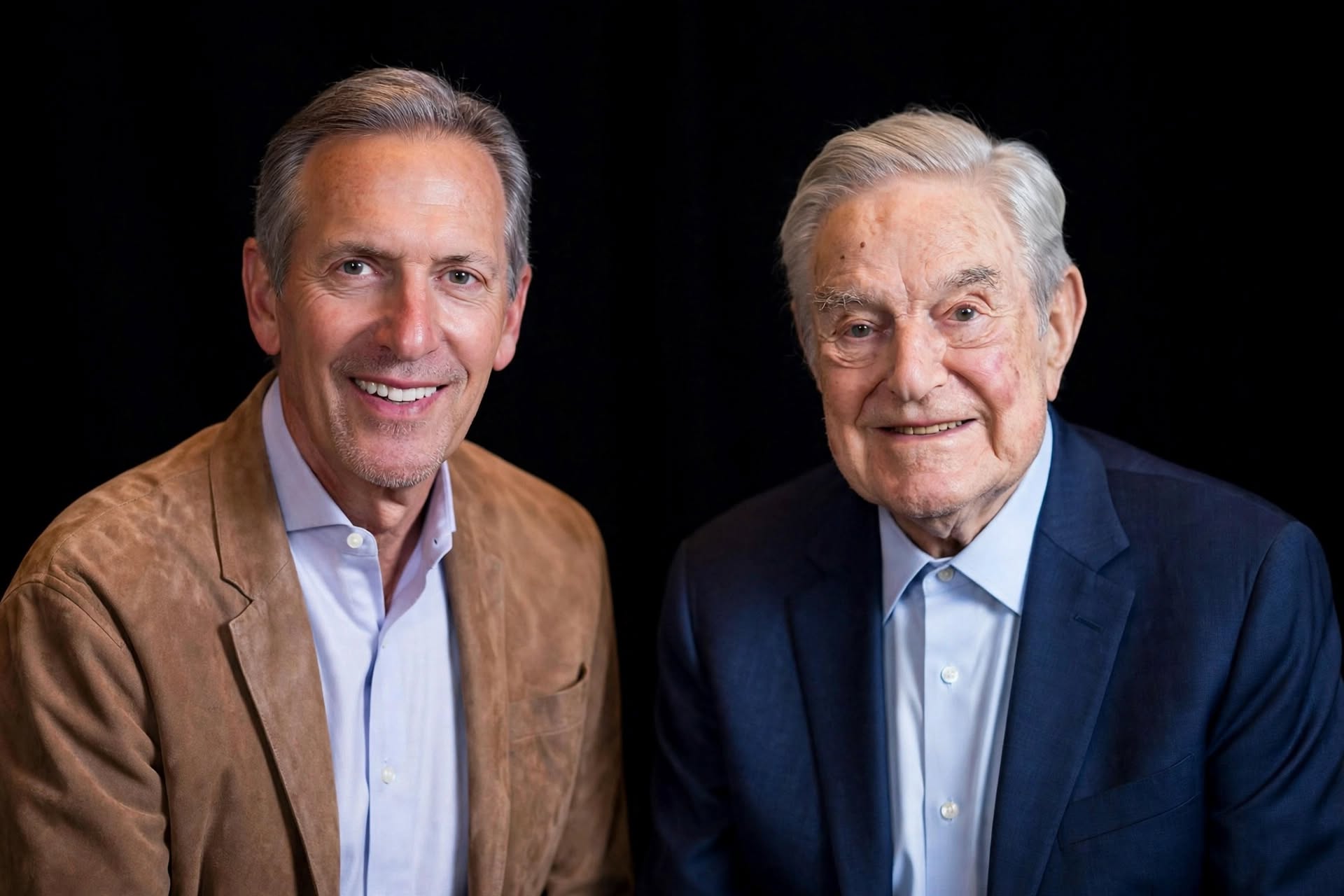
Howard Schultz and George Soros have a documented indirect political connection through American Bridge 21st Century, a political committee that received donations from Soros and filed a federal election complaint against Schultz in 2019. The public sources reviewed for this article do not establish a personal friendship, family relationship or business partnership between the two men.
The distinction is essential: supporting an organisation financially does not, by itself, establish responsibility for its individual decisions. The records identify American Bridge and Bradley Beychok as the complainants against Schultz—not Soros. They also show that the Federal Election Commission ultimately dismissed the allegation.
Who are Howard Schultz and George Soros?
Howard Schultz’s career centres on Starbucks
Schultz is best known for helping transform Starbucks into an international coffeehouse business. According to the company’s historical timeline, he joined Starbucks in 1982 as director of retail operations and marketing. A visit to Italy in 1983 helped inspire his interest in bringing espresso-bar culture to Seattle.
He subsequently founded Il Giornale, which acquired Starbucks’ assets in 1987 with backing from local investors and adopted the Starbucks name. This history makes an important biographical distinction: Starbucks’ first store opened in 1971, before Schultz joined the business. His central contribution was developing the company that followed.
Schultz served several periods as chief executive. He stepped down from Starbucks’ board in September 2023, following his final stint as interim CEO, and became chairman emeritus.
George Soros’s career centres on finance and philanthropy
Soros built his fortune through investing. The Open Society Foundations’ official biography records that he was born in Hungary in 1930, studied at the London School of Economics, moved to the United States in 1956 and launched his own hedge fund in 1970.
His philanthropic work began in 1979 with scholarships for Black South Africans living under apartheid. He later developed the network that became the Open Society Foundations, whose stated mission includes advancing human rights, equity and justice internationally.
Those philanthropic activities provide background on Soros, but the specific connection to Schultz discussed here concerns donations to an American political committee.
How American Bridge connects the two names
American Bridge 21st Century is a Democratic-aligned political committee known for opposition research—collecting information about political opponents for use in campaigns and public debate. The Center for Public Integrity identified Soros among its major donors in reporting on the committee’s fundraising in 2016.
That donor relationship is independently supported by a filing held by the FEC. American Bridge’s 2017 report lists a contribution from George Soros, confirming that his financial support preceded the dispute involving Schultz.
The other side of the connection emerged when Schultz explored an independent campaign for the 2020 U.S. presidential election. American Bridge later filed a complaint challenging whether his activities had triggered candidate registration and financial reporting requirements.
This establishes a limited institutional link: Soros supported a committee that took action against Schultz. It does not establish that the two men collaborated or that Soros personally instructed the committee to file the complaint.
Why Schultz’s possible presidential campaign caused controversy
On January 27, 2019, Schultz said on CBS’s 60 Minutes that he was seriously considering running for president as a centrist independent. His proposal would have placed him outside the Democratic and Republican nomination processes
Some Democrats feared that an independent Schultz candidacy could draw voters away from their eventual nominee and improve President Donald Trump’s chances of reelection. That was a political concern about a possible outcome, rather than evidence of what an election involving Schultz would actually have produced.
On September 6, 2019, Schultz announced that he would not run. ABC News reported that his explanation included the risk of appearing on general-election ballots even if Democrats nominated a moderate candidate, alongside health issues that had interrupted his plans.
The documented episode therefore concerns an exploratory presidential effort that never became a launched independent campaign.
What the election complaint alleged—and how it ended
The dispute concerned candidate reporting obligations
The complaint, dated February 7, 2019 in the FEC’s case record, became Matter Under Review 7567. It alleged that Schultz had gone beyond exploring a possible candidacy and should have registered and reported as a presidential candidate.
The FEC’s general counsel report describes the disputed activities as hiring political consultants, conducting polling and laying groundwork for paid advertising. These were allegations about compliance with U.S. federal campaign-finance requirements, not findings of wrongdoing.
The underlying issue was the boundary between “testing the waters” and becoming a candidate. The report explains that exploratory activities can include polling, telephone calls and travel. Whether someone has crossed that boundary depends on the circumstances; spending money on political exploration does not automatically settle the question.
The FEC dismissed the allegation in 2021
The FEC’s certification dated November 9, 2021 records two unsuccessful 3–3 votes on motions that included different proposed analyses. Commissioners then voted 6–0 to dismiss the allegation and close the file.
The voting history matters because agreement on dismissal did not mean unanimous agreement on the accompanying reasoning. A separate statement by three commissioners explained their view that the available record did not show Schultz’s expenses going beyond permissible exploratory activities.
An account that mentions only the complaint leaves readers without this significant outcome.
What can readers reasonably conclude?
The available evidence supports three distinct facts: Soros donated to American Bridge; American Bridge filed a complaint against Schultz; and the FEC dismissed that complaint. Claims of a direct personal confrontation or a Soros-directed operation would require additional evidence, such as authenticated communications or attributable testimony.
Likewise, describing Schultz and Soros as business partners would require records of a shared venture or formal commercial relationship. None was established by the sources reviewed here. This is a conclusion about the evidence found, not proof that the two men have never met.
The most accurate explanation of Howard Schultz and George Soros is therefore a specific, indirect connection through American political funding and a resolved election complaint. Keeping the donor relationship, the committee’s action and the regulatory outcome separate gives readers a clearer account than treating them as one personal relationship.
Read also James Hamilton McDonough: Meet Neal McDonough’s Youngest Son
