

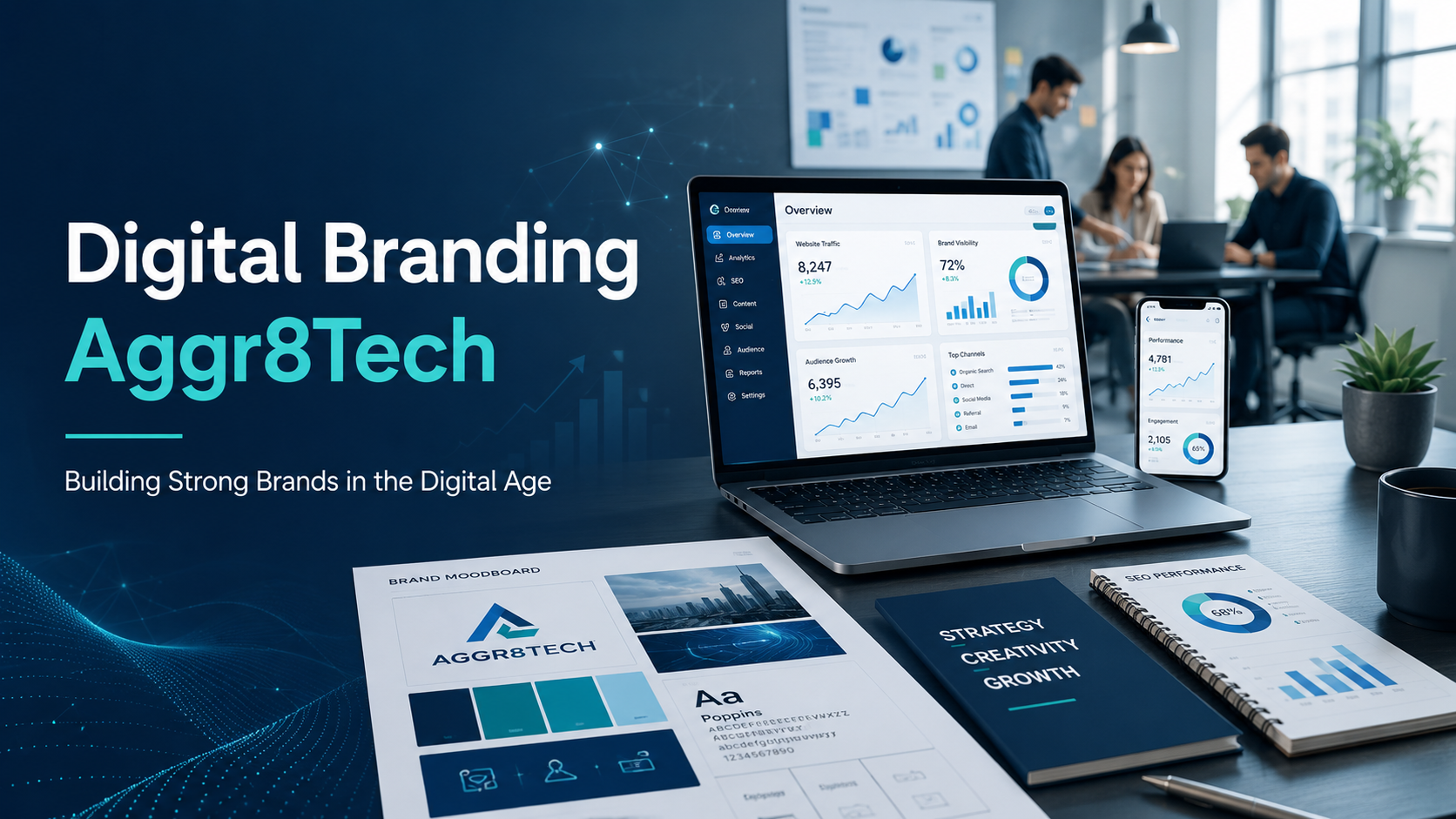
Digital branding has become much more than designing an attractive logo or maintaining a social media account. Modern businesses need a recognizable identity across search engines, websites, social platforms, content channels, and emerging AI-powered discovery experiences.
This is where the idea of digital branding Aggr8Tech comes into focus.
The term is increasingly being used online to describe a technology-driven approach to digital branding in which brand identity, content, SEO, analytics, social media, user experience, and digital tools work together instead of operating as separate activities. Existing coverage of the term commonly connects it with consistent messaging, visual identity, analytics, SEO, content strategy, and social engagement.
Rather than thinking of branding as a single logo, campaign, or website redesign, digital branding Aggr8Tech can therefore be understood as a connected system for creating, communicating, measuring, and strengthening a brand online.
What Is Digital Branding Aggr8Tech?
Digital branding Aggr8Tech refers to the use of branding strategy together with modern digital technologies to create a consistent and recognizable online identity.
The idea combines several areas of digital growth, including:
- Brand positioning and messaging
- Website design and user experience
- Search engine optimization
- Content marketing
- Social media branding
- Analytics and performance measurement
- Automation
- AI-assisted workflows
- Online reputation management
- Visual identity
Instead of managing each channel independently, the goal is to make every digital interaction feel like part of the same brand.
For example, a customer might first discover a company through Google, visit its website, watch one of its videos, check its social media profile, and later subscribe to an email list. Strong digital branding makes those experiences feel connected.
The colors may remain familiar. The tone of voice is recognizable. The value proposition remains clear. Most importantly, the customer receives a consistent impression of who the business is and what it offers.
Why Digital Branding Matters
Consumers can encounter a brand through dozens of digital touchpoints before making a decision.
Your website might create the first impression, but a customer may also evaluate:
- Search results
- Social profiles
- Reviews
- Videos
- Blog posts
- Product pages
- Online communities
- Business listings
Branding therefore extends far beyond visual design.
A strong digital brand helps audiences understand what makes a company different, while repeated and consistent exposure can make the business easier to recognize and remember.
Digital branding Aggr8Tech takes this concept further by connecting branding with technology and measurable digital performance.
The Core Elements of Digital Branding Aggr8Tech
1. Clear Brand Positioning
Every strong digital brand begins with clarity.
A business should be able to answer several basic questions:
Who are we?
Who do we serve?
What problem do we solve?
Why should customers choose us instead of a competitor?
Without clear positioning, even excellent marketing can become inconsistent.
A good positioning statement guides website copy, social content, advertising, visual design, and customer communication.
2. Consistent Visual Identity
Visual identity includes elements such as:
- Logo
- Color palette
- Typography
- Photography
- Icons
- Illustrations
- Page layouts
- Social media templates
The objective is not simply to make everything look attractive. The objective is recognition.
When someone moves from a company’s Instagram account to its website or email newsletter, the visual experience should still feel familiar.
Consistency strengthens the connection between individual pieces of content and the overall brand.
3. Strong Brand Voice
Visual consistency is only half of digital branding.
The way a company communicates also shapes its identity.
A brand may sound:
- Professional
- Friendly
- Technical
- Playful
- Minimal
- Educational
- Premium
- Bold
The right voice depends on the audience and market.
Once established, the same general personality should appear across product descriptions, blog posts, emails, social media updates, videos, and customer support interactions.
4. A High-Quality Website
The website often acts as the central hub of a digital brand.
It should clearly communicate:
- What the business does
- Who the business helps
- What makes it different
- What products or services are available
- What visitors should do next
Performance matters as well.
Google recommends providing a good page experience and specifically highlights factors such as displaying properly across devices and reducing latency. Its Core Web Vitals measure real-world aspects of loading performance, responsiveness, and visual stability.
In practical terms, a branded website should be attractive and fast, accessible, mobile-friendly, and easy to navigate.
SEO and Digital Branding Aggr8Tech
SEO plays an important role because branding has limited value when potential customers cannot discover the business.
Google defines SEO as helping search engines understand content while helping users discover a site and decide whether to visit it.
For a digital branding Aggr8Tech strategy, SEO can include:
- Keyword research
- Helpful blog content
- Clear page titles
- Internal linking
- Technical SEO
- Search-friendly website architecture
- Image optimization
- Relevant backlinks
- Local SEO
- Search Console monitoring
However, keyword optimization should not turn into keyword stuffing.
Google’s current Search Essentials recommend creating helpful, reliable, people-first content while using the terms audiences actually search for in prominent places such as titles and headings.
That means successful digital branding combines visibility with usefulness.
A page should rank because it solves a problem or answers a question well—not simply because the same keyword appears dozens of times.
Content Marketing Builds Brand Authority
Content allows a brand to demonstrate expertise before asking a visitor to buy anything.
Useful content may include:
- Tutorials
- Industry analysis
- Original research
- Case studies
- Comparisons
- Videos
- Guides
- FAQs
- Expert opinions
- Customer stories
The best content does more than attract traffic. It reinforces what the brand wants to be known for.
For example, a cybersecurity business publishing detailed security guides builds a very different identity from one that publishes generic technology news.
The content itself becomes part of the brand.
This distinction has become especially important as AI makes basic content easier to produce. Google’s current guidance for generative AI search encourages businesses to create unique, useful content with original perspectives instead of simply recycling information already available elsewhere.
Social Media and Digital Brand Identity
Social media provides another layer of brand interaction.
While websites are relatively structured, social platforms allow brands to display personality, respond to customers, participate in conversations, and react to trends.
A successful strategy does not require posting on every platform.
Instead, businesses should determine where their target audience spends time.
A B2B technology company may prioritize LinkedIn and YouTube, while a fashion brand may gain more value from Instagram, TikTok, and visual content.
Whatever platforms are selected, messaging should support the same core identity.
Social content should look and sound like it comes from the same organization represented on the company’s website.
The Role of Data and Analytics
One of the defining features of technology-led branding is measurement.
Traditional branding often relied heavily on awareness and perception. Digital channels allow businesses to observe how audiences actually interact with their brand.
Useful metrics can include:
- Branded searches
- Organic traffic
- Direct traffic
- Engagement
- Returning visitors
- Email subscribers
- Social mentions
- Conversion rate
- Customer retention
- Search impressions
A particularly useful development for brand measurement is Google’s branded-query reporting.
Google introduced a branded queries filter in Search Console that separates searches containing a brand name or closely associated products from non-branded searches. Google says this can help website owners understand traffic from people who already know the brand separately from users discovering it through non-branded searches.
That makes search data increasingly useful for measuring both brand recognition and organic discovery.
AI and the Future of Digital Branding Aggr8Tech
Artificial intelligence is changing how brands create content, analyze customers, personalize experiences, and appear in search.
AI can support digital branding through tasks such as:
- Content ideation
- Audience research
- Customer-service automation
- Analytics interpretation
- Creative variations
- Social scheduling
- Personalization
- Search optimization
But automation should not eliminate brand personality.
If every blog post, social caption, and email sounds generic, AI can actually weaken differentiation.
Technology works best when it amplifies a clearly defined brand rather than replacing one.
AI search also introduces another visibility opportunity.
Google says traditional SEO fundamentals remain relevant to its generative AI experiences, including AI Overviews and AI Mode. It recommends valuable content, crawlable websites, strong technical foundations, and good page experiences rather than separate tricks designed exclusively for AI systems.
For digital branding Aggr8Tech, this suggests that the future is not about abandoning SEO. It is about creating a brand that can be understood and discovered across both traditional and AI-powered search experiences.
How to Build a Digital Branding Aggr8Tech Strategy
A practical strategy can be developed in several stages.
Define Your Audience
Identify your ideal customers, their priorities, pain points, digital habits, and preferred communication channels.
Establish Your Brand Position
Determine what your business should be known for and why customers should choose it.
Create Brand Guidelines
Document your colors, typography, logo usage, messaging, tone of voice, imagery, and other identity standards.
Build Your Digital Hub
Create or improve a website that clearly presents your identity, products, services, expertise, and calls to action.
Develop a Search Strategy
Research the problems and questions your audience searches for and build useful pages addressing them.
Create Valuable Content
Publish material that educates, demonstrates expertise, or provides an original perspective.
Connect Your Channels
Maintain recognizable messaging across your website, search presence, social profiles, email campaigns, and other platforms.
Measure Performance
Use analytics, Search Console, social insights, CRM data, and conversion tracking to determine what contributes to awareness and business growth.
Continuously Improve
Branding is not a one-time project.
Markets change. Customer expectations change. Search behavior changes. Platforms change.
Strong digital brands evolve without losing their recognizable core identity.
Benefits of Digital Branding Aggr8Tech
When implemented properly, an integrated digital branding approach can provide several advantages.
Better Brand Recognition
Consistent visuals and messaging make it easier for audiences to identify the business.
Greater Trust
Professional, useful, and consistent digital experiences can strengthen credibility.
Increased Search Visibility
SEO and content allow potential customers to discover the brand while researching relevant topics.
Stronger Customer Relationships
Social media, email, content, and communities provide opportunities for ongoing engagement.
More Informed Decisions
Analytics reveal which channels, messages, and content contribute to results.
Long-Term Brand Equity
Individual campaigns eventually end. A recognizable brand can continue producing value over a much longer period.
Common Digital Branding Mistakes to Avoid
Businesses often weaken their digital identity by focusing too heavily on isolated tactics.
Common mistakes include:
- Changing the visual style constantly
- Using different messaging on every platform
- Publishing content only for search engines
- Copying competitors
- Ignoring website performance
- Trying to use every social platform
- Automating content without maintaining quality
- Measuring followers instead of business outcomes
- Failing to understand the target customer
Another mistake is expecting instant results.
Brand recognition develops through repeated, useful, and consistent interactions over time.
Is Digital Branding Aggr8Tech Worth Considering?
For businesses competing online, the principles behind digital branding Aggr8Tech are highly relevant.
Customers no longer experience brands through a single advertisement or storefront. They interact through websites, search results, social networks, videos, reviews, email, mobile devices, and increasingly AI-powered interfaces.
Managing all of those experiences independently can create inconsistency.
A connected approach brings them together.
The real value of digital branding Aggr8Tech is therefore not a particular tool or platform. It is the idea of treating strategy, identity, content, technology, SEO, user experience, and analytics as parts of one brand ecosystem.
Businesses that can create that consistency are better positioned to become recognizable, discoverable, and trusted online.
Frequently Asked Questions About Digital Branding Aggr8Tech
What is digital branding Aggr8Tech?
Digital branding Aggr8Tech is an emerging term used online to describe a technology-driven approach to building and managing a brand across digital channels. It combines elements such as brand strategy, visual identity, content, SEO, social media, analytics, and digital tools into a connected system.
Is Digital Branding Aggr8Tech an official marketing methodology?
There does not appear to be evidence that it is an established industry-standard methodology. Current online articles generally use the phrase as a conceptual description of integrated, technology-enabled digital branding. Aggr8Tech’s own website currently describes the platform around technology trends, software insights, reviews, tutorials, and emerging technologies rather than presenting “Digital Branding Aggr8Tech” as a formal proprietary branding framework.
What is the difference between digital branding and digital marketing?
Digital branding focuses primarily on how people recognize and perceive a business online, while digital marketing focuses on activities used to attract, engage, and convert customers.
The two overlap significantly. Marketing can generate traffic and sales, while branding helps determine what people remember and associate with the company.
Why is SEO important for digital branding?
SEO helps customers discover a brand when searching for relevant information, products, or services. It also gives businesses an opportunity to establish authority through useful content. Google recommends creating people-first content while making pages understandable and discoverable to search engines.
How does AI affect digital branding?
AI can assist with research, analytics, personalization, automation, customer service, and content production. However, businesses still need original ideas, expertise, clear positioning, and a distinctive voice to prevent their branding from becoming generic.
Does digital branding help with Google AI Overviews and AI Mode?
Strong SEO and high-quality content can help improve overall search visibility. Google states that its existing SEO best practices remain relevant to generative AI features and emphasizes unique, useful content, good technical structure, crawlability, and user experience.
How can a company measure digital brand awareness?
Useful indicators include branded search volume, direct traffic, returning visitors, social mentions, engagement, email subscribers, customer retention, and branded queries in Google Search Console. Google’s branded-query filter can help distinguish traffic from users already familiar with the brand from non-branded organic discovery.
What are the most important elements of a strong digital brand?
The essential elements are clear positioning, consistent messaging, recognizable visual identity, a strong website, useful content, search visibility, appropriate social channels, good customer experiences, and ongoing measurement.
Final Thoughts
Digital branding Aggr8Tech represents a connected approach to building a modern online identity.
Instead of treating SEO, social media, web design, content, analytics, AI, and branding as unrelated activities, businesses can use them together to create one consistent customer experience.
Technology provides the tools, but the foundation remains the same: understand your audience, communicate a clear value proposition, deliver useful experiences, remain recognizable across channels, and continuously measure what works.
In an increasingly crowded digital environment, the brands that combine those elements effectively have a stronger opportunity to earn attention, recognition, trust, and long-term customer loyalty.
Read also: Tech Guru WaveTechGlobal: Technology, Innovation, and What You Should Know
