
Choosing a laser machine for a manufacturing workshop is not simply a matter of comparing wattage, cutting speeds, or purchase prices. The type of material you process has a much greater influence on which technology will deliver the results you need. For UK manufacturers, this distinction is particularly important. Aerospace and automotive subcontractors, electrical switchgear manufacturers, toolmakers, and fabrication businesses often work with a combination of metals, plastics, and other industrial materials. Two of the most common technologies used for these applications are CO2 and fiber lasers. Both can produce excellent results, but they operate at different wavelengths and are designed for different material-processing requirements. Understanding these differences will help you avoid investing in a machine that is unsuitable for your production needs.
1. Understanding How CO2 and Fiber Lasers Work
The main difference between CO2 and fiber lasers is their wavelength.
- CO2 lasers typically operate at a wavelength of approximately 10.6 microns, making them particularly effective for processing non-metallic materials such as acrylic, wood, leather, rubber, and many industrial plastics.
- Fiber lasers operate at approximately 1.06 microns. Their shorter wavelength is absorbed efficiently by many metals, making them suitable for direct marking, engraving, and cutting applications.
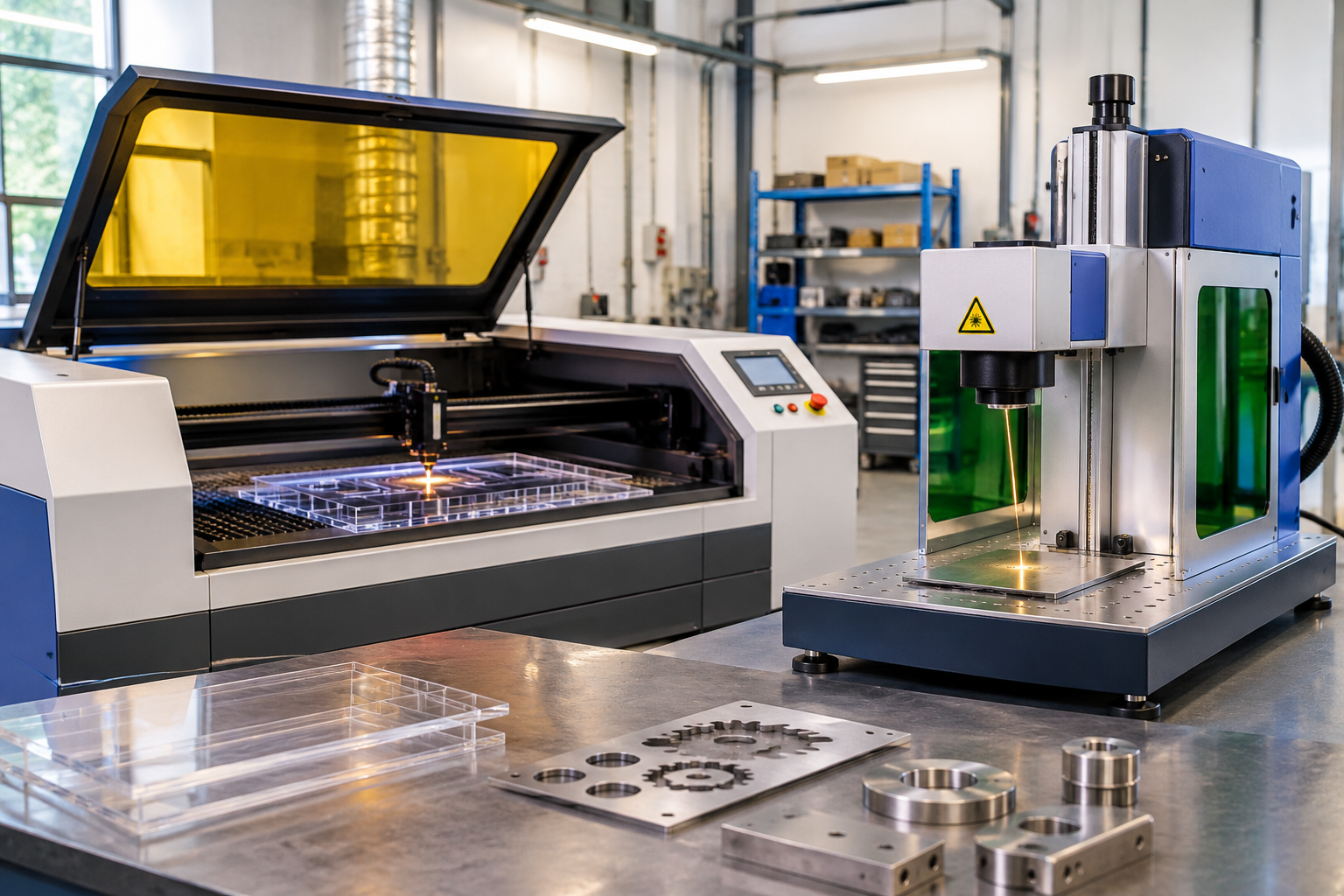
This distinction determines where each machine performs best. A fiber laser is generally the preferred option for manufacturers working primarily with metal components. A CO2 laser is more appropriate for businesses processing acrylic sheets, plastic labels, wooden components, and other non-metallic materials. Neither technology should be treated as a universal replacement for the other.
When Should UK Manufacturers Choose a Fiber Laser?
Fiber laser engravers are particularly useful when permanent metal identification is part of the production process. Manufacturers working with stainless steel, carbon steel, aluminium, brass, and other metals can use fiber systems to produce serial numbers, logos, barcodes, and technical markings. Common applications include:
- Aerospace and automotive components. Suppliers in these industries often need to mark components with identification numbers, traceability information, and other production details. A fiber laser can create permanent markings on compatible metal surfaces without requiring a separate chemical marking compound.
- Electrical switchgear and industrial equipment. Electrical panel manufacturers regularly produce metal rating plates and identification labels. Fiber lasers can mark suitable stainless steel and anodized aluminium plates with text, serial numbers, and data codes. This is useful when producing durable identification that must remain readable throughout the equipment’s service life.
- Toolmakers and engineering workshops. Tools, fixtures, and metal components often require permanent identification.
A fiber laser can mark product names, manufacturing numbers, logos, and other details directly onto compatible metal surfaces. For these applications, even a 20W–30W fiber laser can be a useful starting point for many marking tasks. Higher power may be necessary for deeper engraving or faster production, depending on the material and required marking depth.
When Is a CO2 Laser the Better Choice?
While fiber lasers are excellent for metals, CO2 lasers are particularly effective for non-metallic materials. A UK workshop that regularly processes acrylic, Perspex, wood, leather, rubber, and suitable plastics may find a CO2 machine considerably more useful.
Acrylic and Perspex fabrication
Acrylic is widely used in signage, displays, protective panels, and industrial components. CO2 lasers can cut and engrave suitable acrylic sheets, producing clean edges and detailed designs. This makes them particularly useful for manufacturers producing custom panels, machine guards, display components, and plastic enclosures.
Electrical identification labels
Many electrical workshops use multilayer engraving plastics, including suitable Traffolyte and Resopal-type materials. These products have contrasting layers that allow the laser to remove the upper surface and reveal a different colour underneath. A CO2 laser is particularly suitable for this type of processing, allowing manufacturers to produce custom legends, control-panel labels, and identification plates. However, always confirm the exact material formulation and laser compatibility before processing.
Industrial non-metallic components
CO2 lasers can also process suitable rubber, wood, leather, and other non-metallic materials. For manufacturers producing industrial gaskets, protective labels, and customised components, this flexibility can be valuable. The important limitation is that standard CO2 machines cannot directly engrave bare stainless steel, aluminium, or brass in the same way as a fiber laser. Specialist marking compounds can sometimes be used to create marks on compatible metal surfaces, but this is not equivalent to direct fiber engraving.
Comparing the Two Technologies
| Application | Fiber laser | CO2 laser |
| Bare stainless steel marking | Excellent | Not suitable directly |
| Aluminium marking | Excellent, depending on finish | Limited to suitable coatings or marking compounds |
| Brass marking | Suitable | Not suitable directly |
| Acrylic cutting | Generally unsuitable | Excellent |
| Traffolyte labels | Material-dependent | Excellent for compatible grades |
| Wood engraving | Generally unsuitable | Excellent |
| Leather engraving | Material-dependent | Suitable for compatible leather |
| Metal serial numbers | Excellent | Requires suitable coatings or marking compounds |
This comparison highlights why manufacturers should evaluate their materials before choosing a machine. A business that primarily marks metal components will have different requirements from one producing acrylic panels and plastic labels.
Can One Machine Handle Both Metal and Plastic Production?
For smaller workshops, investing in a single machine may seem like the most affordable option. However, trying to make one laser technology handle every application can introduce unnecessary limitations.
- A fiber laser may be excellent for stainless steel identification plates but unsuitable for cutting the acrylic panels your customers require. Likewise, a CO2 machine may produce excellent acrylic components but cannot replace a fiber laser when you need direct metal engraving. This is why some growing manufacturers eventually adopt a two-machine setup.
- A dedicated fiber laser handles metal marking and engraving, while a separate CO2 machine processes acrylic, wood, and other non-metallic materials.
This approach allows each machine to perform the tasks it is designed for, reducing production compromises. It can also make workflow planning easier when both material categories represent regular sources of business.
What Should You Consider Before Buying?
Beyond the laser source, there are several practical factors worth evaluating.
- Production volume. Consider how many components you expect to process each day. A machine that works for occasional identification tasks may not be suitable for a workshop handling hundreds of parts.
- Marking requirements. Determine whether you need surface marking, deep engraving, cutting, or simply high-contrast identification. For example, marking a serial number on stainless steel requires different settings from producing a deep engraved logo.
- Working area. Fiber galvo systems typically have smaller marking fields than gantry-style CO2 machines. Check that the working area accommodates your largest components.
- Software compatibility. Your machine should integrate with your existing design and production processes. LightBurn is used with many compatible CO2 and fiber laser systems, but compatibility depends on the controller and machine configuration.
- Workshop safety. Both technologies require appropriate laser safety measures, extraction, and operator training. Enclosed systems, interlocks, and suitable protective equipment should be considered when planning a commercial installation.
Exploring OMTech CO2 Laser Solutions
For UK manufacturers whose primary requirement is processing acrylic, plastic labels, wood, and other non-metallic materials, OMTech Pro CO2 Laser Cutters are worth considering. They can support applications such as cutting acrylic panels, engraving multilayer identification plastics, producing industrial signage, and processing suitable workshop components. If metal marking is a major part of your business, however, you should evaluate a dedicated fiber laser rather than expecting a CO2 system to perform the same function.
Final Thoughts
CO2 and fiber lasers serve different purposes in manufacturing, and understanding their strengths is essential before investing in either technology. Fiber lasers are particularly valuable for direct metal marking, engraving, and serialisation. CO2 systems are better suited to acrylic fabrication, multilayer plastic labels, wood, and other non-metallic materials.
For UK manufacturers handling both categories regularly, a dedicated machine for each process may eventually provide the most practical solution. By matching your equipment to your materials and production requirements, you can build a more efficient and reliable manufacturing workflow.
