
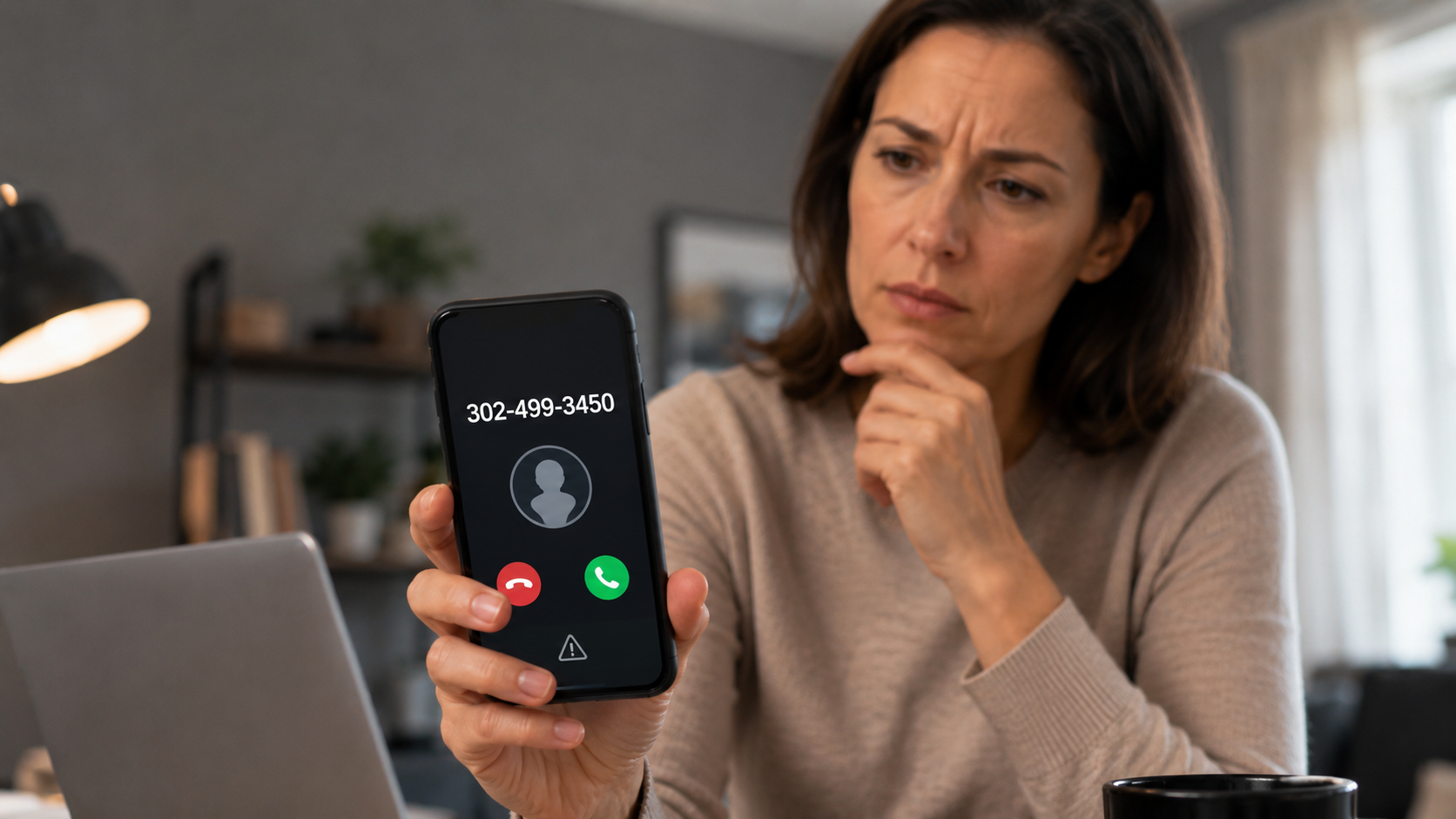
Receiving an unexpected call from 3024993450 can leave you wondering who is behind the number and whether it is safe to answer or call back. Unknown calls are common, but identifying them accurately is not always as simple as checking the number displayed on your screen.
The number 302-499-3450 uses the 302 area code, which covers the State of Delaware. Delaware government sources confirm that 302 serves the entire state.
However, an area code alone cannot identify the caller. More importantly, it does not prove that the person making the call is actually located in Delaware. Caller ID information can be manipulated, which is why an unfamiliar number should be verified before you provide personal details, make a payment, or return a suspicious call.
What Is 3024993450?
3024993450 is a ten-digit U.S. telephone number using Delaware’s 302 area code. Searches conducted for this article did not reveal a reliable government, established business, or other authoritative public source confirming the current owner of this specific number.
That distinction matters. A number appearing on random websites, comment pages, or reverse-lookup databases does not automatically establish who owns or operates it. The absence of a verified public listing also does not automatically mean that 3024993450 is fraudulent.
It may belong to a private individual, a business whose number is not widely indexed, or another legitimate caller. It is also possible for the number shown on caller ID to have been spoofed.
For that reason, the safest conclusion is that the identity behind 3024993450 cannot presently be confirmed from reliable public information.
Is 3024993450 a Scam Number?
There is not enough reliable evidence to label 3024993450 as a confirmed scam number.
At the same time, you should not assume that a call is trustworthy simply because the telephone number appears normal. The Federal Trade Commission warns consumers that scammers can manipulate caller ID so that almost any name or number appears on a phone screen.
The Federal Communications Commission gives similar advice. According to the FCC, caller ID spoofing involves deliberately falsifying caller information to disguise the caller’s true identity. The agency advises consumers to be cautious when answering calls from numbers they do not recognize.
Therefore, whether 3024993450 is safe depends more on what happens during the call than on the digits themselves.
Why Does the 302 Area Code Matter?
The 302 area code is associated with Delaware, and unlike many states that use numerous area codes, 302 historically covers the entire state. Delaware itself describes 302 as the area code encompassing the state.
This can make a 302 call look familiar to someone living in Delaware or doing business there.
Scammers understand that people may be more likely to answer calls that appear local. The FTC specifically warns that caller ID can be spoofed to make a call appear to originate from a local telephone number even when the real caller is somewhere else.
Delaware authorities have also previously warned residents about scams in which callers used numbers carrying the 302 area code. Those warnings demonstrate why a local-looking number should not, by itself, be considered proof of legitimacy.
Signs the Call May Be Suspicious
Instead of judging 3024993450 only by its caller ID, pay attention to the caller’s behavior.
Common warning signs include:
- Demanding immediate payment or creating artificial urgency.
- Threatening arrest, account suspension, fines, or other consequences unless you act immediately.
- Asking for a Social Security number, banking information, passwords, verification codes, or credit card details unexpectedly.
- Insisting that payment must be made using gift cards, cryptocurrency, wire transfers, bank transfers, or payment apps.
- Asking you to install software or provide remote access to your computer or smartphone.
- Claiming to represent a government agency while demanding unexpected payment.
- Refusing to let you hang up and independently verify the caller’s identity.
The FTC warned in July 2026 that when an unexpected caller says the only way to solve a supposed problem or receive something is through methods such as gift cards, wire transfers, cryptocurrency, bank transfers, or payment apps, that is a strong scam warning sign.
A genuine organization should normally allow you to independently verify who is contacting you.
What to Do After a Call From 3024993450
If you missed a call from 3024993450, there is usually no need to immediately return it.
Check whether the caller left a voicemail. A legitimate caller with an important reason to contact you will often provide enough information for you to identify the purpose of the call.
If the voicemail claims to come from a bank, government department, delivery company, insurance provider, utility company, or another recognizable organization, do not rely on the callback number provided by the caller.
Instead, find the organization’s official contact information independently and contact it through its published number. This prevents you from simply reconnecting with someone who may be impersonating the organization.
The FTC specifically cautions consumers not to trust caller ID as proof of identity because displayed names and telephone numbers can be faked.
If You Answered the Call
Simply answering an unknown call does not necessarily mean something bad has happened.
The important issue is what information you provided and what actions the caller persuaded you to take.
If the person calling from 3024993450 begins requesting sensitive information, payment, account credentials, security codes, or remote access, end the call and verify the request separately.
Never provide a one-time verification code to an unexpected caller. Security codes are generally intended to confirm actions on your own account and can be valuable to criminals attempting unauthorized access.
If you recognize the organization the caller claims to represent, use its official website, account statement, bank card, government directory, or another trusted source to find the correct contact number.
If You Received a Text
The same cautious approach applies if 3024993450 sends you a text message.
Do not click an unexpected link merely because the message contains your name, mentions a package, warns about an account, or claims that you owe money.
The FTC recommends reporting suspicious spam texts through your messaging service and says consumers can forward suspicious messages to 7726 (SPAM). Reports can also be submitted to the FTC.
If a text appears to come from a company you use, open that company’s official app or website separately instead of using the link supplied in the message.
Should You Block 3024993450?
If 3024993450 repeatedly calls without a legitimate reason, blocking the number is a reasonable option.
Modern smartphones normally provide a built-in method for blocking individual callers. Phone carriers and third-party services may also provide spam-detection or call-filtering tools.
Keep in mind, however, that blocking one telephone number does not stop every unwanted call. If the displayed number was spoofed, the same caller may later use a different number.
The FCC encourages consumers to use available call-blocking and call-labeling tools to reduce unwanted calls.
How to Report the Number
If a call from 3024993450 involves fraud, impersonation, unwanted robocalling, or suspicious requests, reporting it can help authorities identify broader patterns.
The Federal Communications Commission accepts complaints concerning unwanted calls, robocalls, texts, and spoofed telephone numbers. The FCC explains that consumer complaints provide information that may contribute to enforcement activities and policy decisions.
Fraud and scam attempts can also be reported to the Federal Trade Commission through ReportFraud. The FTC specifically encourages people who have lost money or received information about a suspected phone scam to submit a report.
Consumers receiving unwanted telemarketing calls can also use the National Do Not Call Registry to register eligible telephone numbers and report unwanted calls.
If You Already Paid the Caller
Act quickly if someone associated with an unexpected call persuaded you to send money.
Contact the bank, card issuer, payment service, cryptocurrency exchange, wire-transfer provider, or gift-card company involved and explain that you believe the transaction resulted from fraud. Ask whether the payment can be stopped, reversed, or otherwise investigated.
The FTC provides specific recovery steps depending on how money was sent and recommends reporting the incident through its fraud-reporting system.
You should also change affected passwords if you disclosed login information and contact the appropriate institution immediately if banking or financial details were exposed.
Can Reverse Lookup Sites Be Trusted?
Reverse telephone lookup services can sometimes provide useful clues, but their results should not be treated as definitive proof of identity.
Telephone numbers may change users, business details may become outdated, and community-generated spam labels depend on reports that are not always independently verified.
Caller ID spoofing introduces another problem: the actual owner of a number may have nothing to do with a suspicious call made while that number was displayed.
For important decisions, information from official agencies, the organization supposedly making the call, your telephone carrier, or another independently verified source is more reliable than an anonymous online comment.
Final Verdict on 3024993450
At present, there is no reliable evidence reviewed for this article that conclusively identifies the owner of 3024993450 or proves that it is a scam number.
What can be confirmed is that the 302 area code belongs to Delaware.
What cannot be confirmed from caller ID alone is who actually placed a particular call. Both the FTC and FCC warn that phone numbers can be spoofed, meaning a familiar or local-looking number should never be treated as automatic proof that a caller is genuine.
If the call was unexpected, the sensible approach is simple: do not share sensitive information, do not make an immediate payment, verify claimed organizations independently, and block or report the number when the behavior appears suspicious.
FAQs About 3024993450
Who owns 3024993450?
No reliable public source reviewed for this article confirms the current owner of 3024993450. Avoid accepting an unverified reverse-lookup listing as definitive proof of identity.
Where is 3024993450 located?
The number uses the 302 area code, which covers Delaware. However, that does not prove the caller was physically located in Delaware when the call was made.
Is 3024993450 a scam number?
There is currently insufficient reliable evidence to describe 3024993450 as a confirmed scam number. Judge the call by its behavior and verify any claims independently before providing information or money.
Can scammers fake 3024993450 on caller ID?
Yes. Caller ID numbers can be spoofed. Both the FTC and FCC warn that scammers can falsify the number or name appearing on a recipient’s phone.
Should I call 3024993450 back?
If you do not recognize the number, checking for a voicemail first is safer than immediately calling back. If the caller claims to represent an organization, contact that organization using independently verified contact information.
Should I block 3024993450?
Blocking it can be appropriate if you are receiving repeated unwanted or suspicious calls. Remember that blocking one number may not prevent future calls when spoofed numbers are being used.
What should I do if the caller asks for money?
Do not make an immediate payment. Be especially cautious if an unexpected caller demands gift cards, cryptocurrency, wire transfers, bank transfers, or payments through an app. The FTC identifies these types of demands as important scam warning signs.
Where can I report a suspicious call from 3024993450?
Suspected fraud can be reported to the FTC, while unwanted calls, robocalls, texts, and caller-ID spoofing can be reported to the FCC. Unwanted telemarketing calls can also be reported through the National Do Not Call Registry.
